


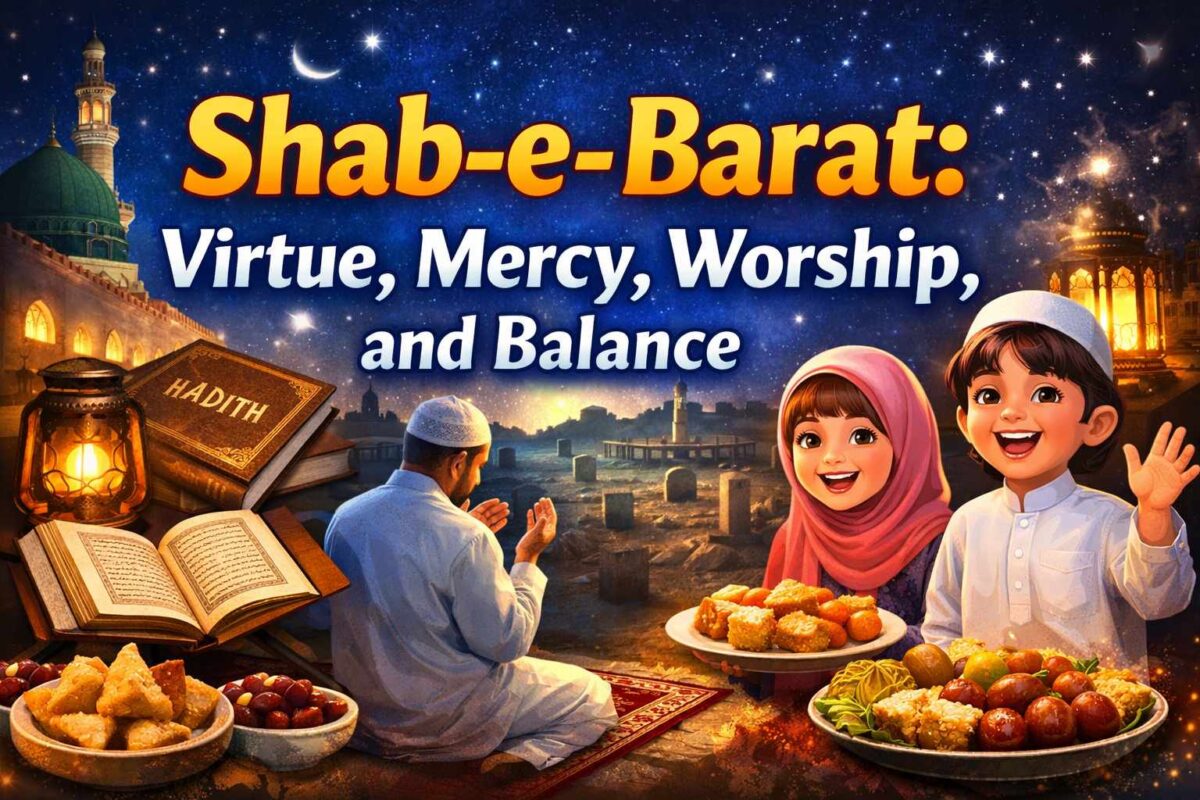
Shab-e-Barat: A Holistic, Qur’an-and-Hadith–Based Understanding
Virtue, Mercy, Worship, and Balance — without denial, without exaggeration
Why Shab-e-Barat needs a calm, complete discussion
Shab-e-Barat is one of those nights that should soften hearts, but instead often hardens attitudes.
Some people turn it into uncontrolled ritual and noise; others try to erase its virtue completely and scare Muslims away from worship.
Both approaches are imbalanced.
Islam is not built on fear-based religion, nor on emotion without discipline.
It is built on Qur’an, Sunnah, accepted scholarly principles, and wisdom developed over 1400 years.
This article is written holistically, based on:
-
Qur’anic principles
-
All major ahadith about the middle night of Sha‘ban
-
Accepted Sunni scholarly methodology
-
Historical practice of the Ummah
-
Respect for difference without condemnation
No slogans.
No gatekeeping of Allah’s mercy.
No denial of authentic narrations.
1. Qur’anic foundations: How Islam views time, mercy, and forgiveness
1.1 Allah chooses times — humans don’t invent mercy
The Qur’an establishes a foundational rule:
“Your Lord creates what He wills and chooses.” (28:68)
Allah chooses:
-
Certain people
-
Certain places
-
Certain times
Ramadan is chosen.
Laylatul Qadr is chosen.
Jumu‘ah is chosen.
So the concept of a blessed night is entirely Qur’anic.
It is not a later cultural idea.
1.2 Allah’s mercy is vast and repeatedly opened
The Qur’an repeatedly calls Allah:
-
Al-Ghafūr (Most Forgiving)
-
Ar-Raḥīm (Most Merciful)
And declares:
“Do not despair of the mercy of Allah.” (39:53)
When ahadith speak about a night of mass forgiveness, they are not contradicting the Qur’an — they are illustrating it.
2. What is Shab-e-Barat?
Shab-e-Barat refers to the 15th night of Sha‘ban, known in classical texts as:
Laylat an-Nisf min Sha‘ban (the middle night of Sha‘ban)
The word Barat (used in South Asia) conveys meanings of:
-
Freedom from sin
-
Release from burden
-
Divine pardon
This terminology is cultural — the night itself is Prophetic.
3. Shab-e-Barat in the Ahadith
3.1 The core hadith of mass forgiveness
The Prophet ﷺ said:
“Allah looks at His creation on the middle night of Sha‘ban and forgives all of them, except the mushrik and the one who harbours hatred.”
This narration is reported through multiple companions and preserved by major hadith scholars.
Key meaning:
-
Allah’s mercy is widespread
-
Forgiveness is real
-
Certain spiritual diseases (shirk, deep hatred) block forgiveness
This hadith alone establishes that:
The night is not ordinary.
3.2 “More than the hairs of Banū Kalb”
The Prophet ﷺ said that Allah forgives on this night:
“More people than the number of hairs on the sheep of Banū Kalb.”
This is intentional language, not exaggeration:
-
Banū Kalb were famous for massive flocks
-
The phrase indicates immense forgiveness
This hadith is widely cited in classical works of hadith and fiqh.
3.3 The hadith of Sayyidah ‘Ā’ishah (رضي الله عنها) — Jannat-ul-Baqi‘
Sayyidah ‘Ā’ishah (رضي الله عنها) narrates:
She could not find the Prophet ﷺ at night, went looking for him, and found him in Jannat-ul-Baqi‘.
He ﷺ then informed her about Allah’s mercy and forgiveness on the middle night of Sha‘ban.
This narration proves several important points:
-
The Prophet ﷺ was awake on this night
-
He was engaged in worship
-
He visited the graveyard quietly
-
He informed his wife of the night’s virtue
Anyone claiming:
“There is no basis at all for Shab-e-Barat”
is ignoring this narration.
4. A crucial Sunni principle: Weak hadith in virtues
Across Sunni scholarship, there is a well-established rule:
Weak hadith are accepted in faḍāʾil al-a‘māl (virtues of deeds)
With conditions:
-
The hadith is not fabricated
-
It does not create new beliefs
-
It does not declare haram/halal or farz
Shab-e-Barat falls squarely under virtues, not legislation.
Therefore:
-
Using these ahadith for encouragement is valid
-
Erasing the night entirely is not Sunni methodology
5. Did the Sahabah practice Shab-e-Barat?
This question is often misunderstood.
What the Sahabah did NOT do
-
They did not declare it an Eid
-
They did not organize public festivals
-
They did not fix ritual formulas
What they DID do
-
Recognized the night’s virtue
-
Engaged in quiet worship
-
Made du‘ā’
-
Reflected and sought forgiveness
The difference between then and now is form, not essence.
6. “Isn’t this only celebrated in India, Pakistan, Bangladesh?”
This claim is historically incorrect.
Reality:
-
Scholars of Hijaz, Sham, Iraq, Yemen, Khurasan discussed this night centuries before Islam reached South Asia
-
Classical hadith and fiqh books mention Laylat an-Nisf min Sha‘ban
-
What is regional is expression, not recognition
South Asia expresses religious nights publicly.
Arab lands often express them quietly.
Culture adds style — not belief.
7. Does a blessed night naturally create a festive feeling?
Yes — and Islam does not deny human emotion.
Ramadan feels special.
Laylatul Qadr feels special.
Jumu‘ah feels special.
Feeling:
-
Joy
-
Hope
-
Spiritual excitement
is natural and halal.
What Islam rejects is:
-
Noise
-
Waste
-
Showing off
-
Policing others
Festive hearts ✔️
Festive chaos ❌
8. Is Shab-e-Barat a “proof of salvation”?
8.1 What the ahadith clearly establish
-
Allah’s mercy descends
-
Forgiveness is vast
-
Doors of mercy are wide open
So yes:
Shab-e-Barat is a night of forgiveness and hope for salvation.
8.2 What the ahadith themselves restrict
The same narrations exclude:
-
Mushrik
-
One filled with hatred
Meaning:
-
Forgiveness is offered
-
But not automatic without repentance
This is balance, not denial.
9. What the Prophet ﷺ did — and did NOT do
He DID:
-
Worship at night
-
Make du‘ā’
-
Seek forgiveness
-
Visit graves quietly
He did NOT:
-
Declare a festival
-
Fix rak‘ah numbers
-
Prescribe special public rituals
This teaches us:
The night is spiritual, personal, and humble — not performative.
10. What Muslims SHOULD do on Shab-e-Barat
10.1 Sincere repentance (tawbah)
-
Admit sins
-
Feel regret
-
Resolve to change
-
Ask Allah directly
No scripts. No intermediaries.
10.2 Du‘ā’
Ask Allah for:
-
Forgiveness
-
Guidance
-
Protection
-
Rizq
-
A good ending
Your own language is enough.
10.3 Nafl prayer
-
Any amount
-
Any style
-
Individually
Without invented formulas or guarantees.
10.4 Remembering the dead & forgiving the living
-
Du‘ā’ for parents and deceased
-
Forgive people who hurt you
Remember:
Hatred blocks forgiveness — the hadith itself says so.
10.5 Charity (ṣadaqah)
Charity:
-
Wipes sins
-
Attracts mercy
Give because Allah loves generosity — not because the night “forces” you.
11. What should NOT be done
❌ Declaring it farz or wajib
❌ Declaring it an Eid
❌ Inventing prayers with guaranteed outcomes
❌ Declaring Muslims misguided or jahannami
❌ Turning ikhtilaf into hostility
12. A historical reality many ignore
For over 1400 years:
-
The Ummah recognized this night
-
Scholars corrected excess, not erased virtue
-
Differences existed without hatred
If exaggeration were inevitable, Islam would not have survived.
The “shut-it-down” mentality is modern — not classical.
13. About preaching, stopping others, and fear-based religion
There is a major difference between:
-
Personal abstention ✔️
-
Forcing others to stop ❌
Sunni principle:
There is no condemnation in matters of scholarly disagreement.
Blocking voluntary worship harshly:
-
Has no Qur’anic command
-
Has no Prophetic model
-
Causes division
Turning mercy into fear serves Shayṭān’s goal, not Allah’s.
14. Final balanced conclusion
Shab-e-Barat is:
✔️ A blessed night
✔️ A night of mercy
✔️ A night of forgiveness
✔️ A night of hope
But it is:
❌ Not an Eid
❌ Not compulsory
❌ Not a weapon against Muslims
The safest Sunni path:
Accept the virtue.
Worship with humility.
Avoid exaggeration.
Reject condemnation.
Leave hearts to Allah.
A final line to remember
Allah opens doors of mercy —
no group has the right to stand in the doorway.
