


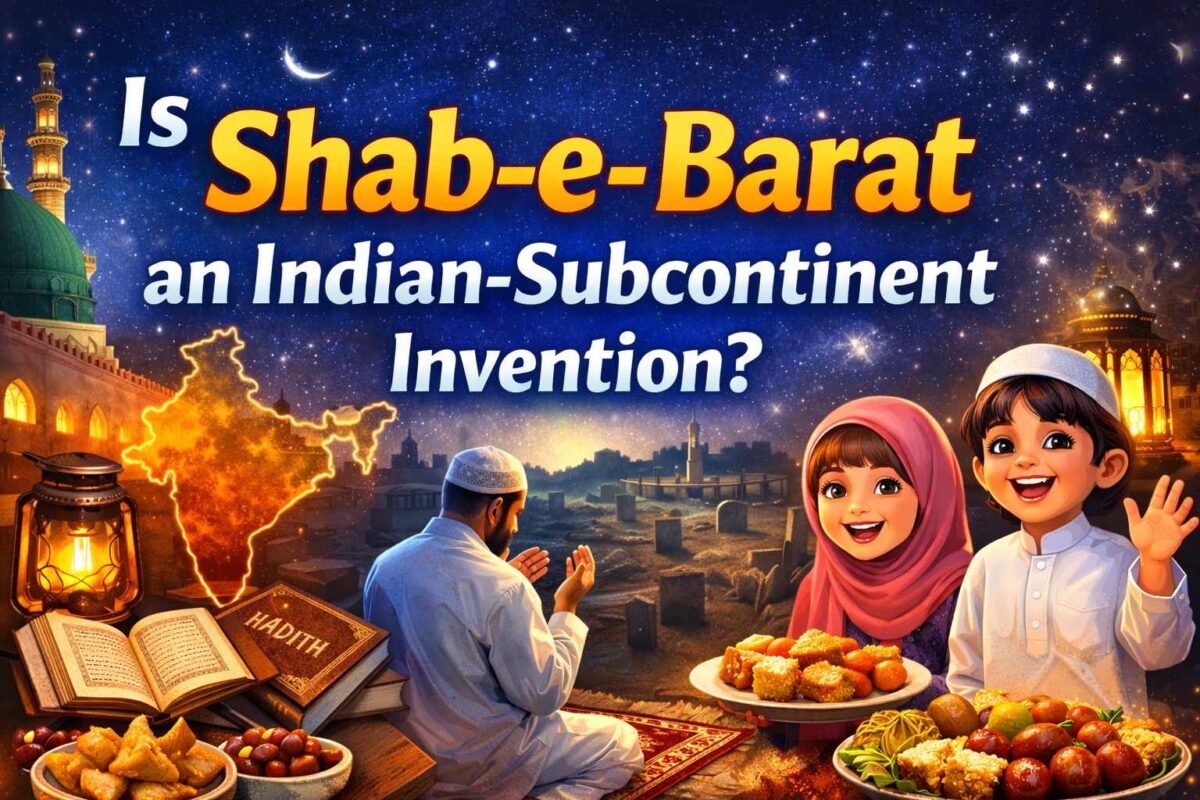
Is Shab-e-Barat an Indian-Subcontinent Invention?
A historical, hadith-based, and scholarly examination
Introduction: Where this claim comes from
A common claim heard today is:
“Shab-e-Barat is an Indian, Pakistani, or Bangladeshi invention.
The Sahabah didn’t do it, so it must be cultural.”
This statement sounds confident, but confidence is not evidence.
When we examine hadith literature, early Islamic history, and classical scholarship, this claim does not stand.
This article answers one question factually, not emotionally:
Did Shab-e-Barat originate in the Indian subcontinent,
or does it pre-date Islam’s arrival there?
1. First, clarify the confusion: origin vs expression
Before going further, one crucial distinction must be made:
-
Origin → where a belief or practice comes from
-
Expression → how different cultures display it
South Asia is known for public, expressive religious culture.
Arab lands tend to be quiet and private.
❗ Different expression does NOT mean different origin.
So the real question is not:
“Why does it look South Asian today?”
But:
“Was the virtue of the night known before Islam reached South Asia?”
2. When did Islam reach India in full scholarly form?
-
Early Muslim contact: 1st–2nd century AH
-
Scholarly institutions & mass Islam: much later
-
Major Indian Islamic empires: 10th–16th century CE
Now compare this with the dates of hadith and fiqh books.
3. Shab-e-Barat in hadith books written outside South Asia
Sunan Ibn Mājah
Author: Imam Ibn Mājah (d. 273 AH)
Region: Persia (Iran)
Contains the famous hadith:
“Allah looks at His creation on the middle night of Sha‘ban and forgives all of them, except the mushrik and the one who harbours hatred.”
📌 Written in the 3rd century Hijri
📌 Centuries before Islam institutionalized in India
Musnad Ahmad
Author: Imam Ahmad ibn Hanbal (d. 241 AH)
Region: Baghdad
Contains multiple narrations about:
-
Mid-Sha‘ban
-
Divine forgiveness
-
Allah’s mercy descending
Baghdad is not South Asia.
Al-Mu‘jam al-Kabīr
Author: Imam al-Ṭabarānī (d. 360 AH)
Region: Sham & Iraq
Preserves narrations from:
-
Mu‘adh ibn Jabal (رضي الله عنه)
-
Abu Tha‘labah (رضي الله عنه)
-
Sayyidah ‘Ā’ishah (رضي الله عنها)
All regarding Laylat an-Nisf min Sha‘ban.
4. Sahabah evidence: Was the night known to them?
The hadith of Sayyidah ‘Ā’ishah (رضي الله عنها)
She narrates that she could not find the Prophet ﷺ one night and later found him in Jannat-ul-Baqi‘, where he informed her of Allah’s mercy and forgiveness on the middle night of Sha‘ban.
📌 This proves:
-
The Sahabah knew this night
-
The Prophet ﷺ spoke about its virtue
-
This happened in Madinah, not India
So the claim:
“Sahabah didn’t know about it”
❌ Factually incorrect.
5. Tabi‘een and early scholars: Was it discussed?
Yes — extensively.
Shu‘ab al-Īmān
Author: Imam al-Bayhaqī (d. 458 AH)
Region: Khurasan (Iran)
He gathered all narrations on:
-
Mid-Sha‘ban
-
Its virtues
-
Forgiveness
He explained why the narrations are accepted collectively, especially in virtues.
Ihya’ ‘Ulum al-Din
Author: Imam al-Ghazālī (d. 505 AH)
Region: Persia
Explicitly lists Laylat an-Nisf min Sha‘ban among virtuous nights
and encourages personal worship, not ritual excess.
6. Classical fiqh books — still not India
Al-Mughni
Author: Ibn Qudāmah (d. 620 AH)
Region: Damascus
Mentions:
-
Scholars of Sham recognizing the night
-
Individual worship being praiseworthy
-
Excessive ritual being discouraged
Lata’if al-Ma‘arif
Author: Imam Ibn Rajab al-Hanbalī (d. 795 AH)
Region: Damascus
Contains a full chapter on:
-
Mid-Sha‘ban
-
Practices of early Muslims
-
Scholarly differences
Still not India.
7. Even critics did not deny the night
Fatawa Ibn Taymiyyah
Despite later polemics, Ibn Taymiyyah himself wrote:
“The virtue of the middle night of Sha‘ban is established through many narrations…
praying individually on this night is good.”
📌 He:
-
Accepted the virtue
-
Discouraged ritualization
-
Did not deny the night
Again — Damascus, not South Asia.
8. So why does it look “South Asian” today?
Because culture shapes expression, not belief.
-
Arabs → quiet worship at home
-
Turks → mosque-centered nights
-
South Asia → public gatherings, lights, sweets
📌 Expression ≠ invention
No one says:
-
Qur’an printing is an Indian invention
-
Madrasas are Indian inventions
-
Loudspeakers are Indian Islam
Yet these also took visible form in South Asia.
9. The decisive timeline (simple and undeniable)
| Century | Region | Evidence |
|---|---|---|
| 2nd–3rd AH | Iraq / Persia | Ahmad, Ibn Mājah |
| 4th AH | Sham / Iraq | Ṭabarānī |
| 5th AH | Khurasan | Bayhaqī, Ghazālī |
| 6th–8th AH | Damascus | Ibn Qudāmah, Ibn Rajab |
| Later | South Asia | Cultural expression |
👉 Origin clearly precedes South Asia.
Final conclusion (clear and factual)
Shab-e-Barat is NOT an Indian-subcontinent invention.
-
It is rooted in Prophetic ahadith
-
Known to the Sahabah
-
Discussed by the Tabi‘een
-
Preserved by hadith scholars of Iraq, Sham, Hijaz, and Khurasan
-
Practiced differently across cultures
What South Asia added is expression, not theology.
One line to remember
A practice documented in Madinah, Baghdad, Damascus, and Khurasan
cannot honestly be called an Indian invention.
