


Introduction
Disclaimer:
The sole aim of this article is to elevate awareness of the Prophet’s ﷺ sacred rank and protect believers from unintentional disrespect. It seeks to educate, not to create division or hatred among Muslims.
The late 19th and early 20th century in the Indian subcontinent was a period of profound intellectual ferment within Sunni Islam. The advent of the printing press, rising literacy, and an expanding public sphere meant that theological debates, once confined to scholarly circles, now reached a broad audience. Reformist writings, polemical tracts, and novel interpretations began circulating widely, challenging traditional paradigms. While theological discourse has always been part of Islam’s intellectual life, certain writings during this period ventured into a domain considered sacred and inviolable: the status, knowledge, and dignity of the Prophet Muhammad ﷺ. These writings triggered deep concern among traditional Sunni scholars, who saw them not as mere differences of opinion, but as potential deviations from the foundational creed of Islam.
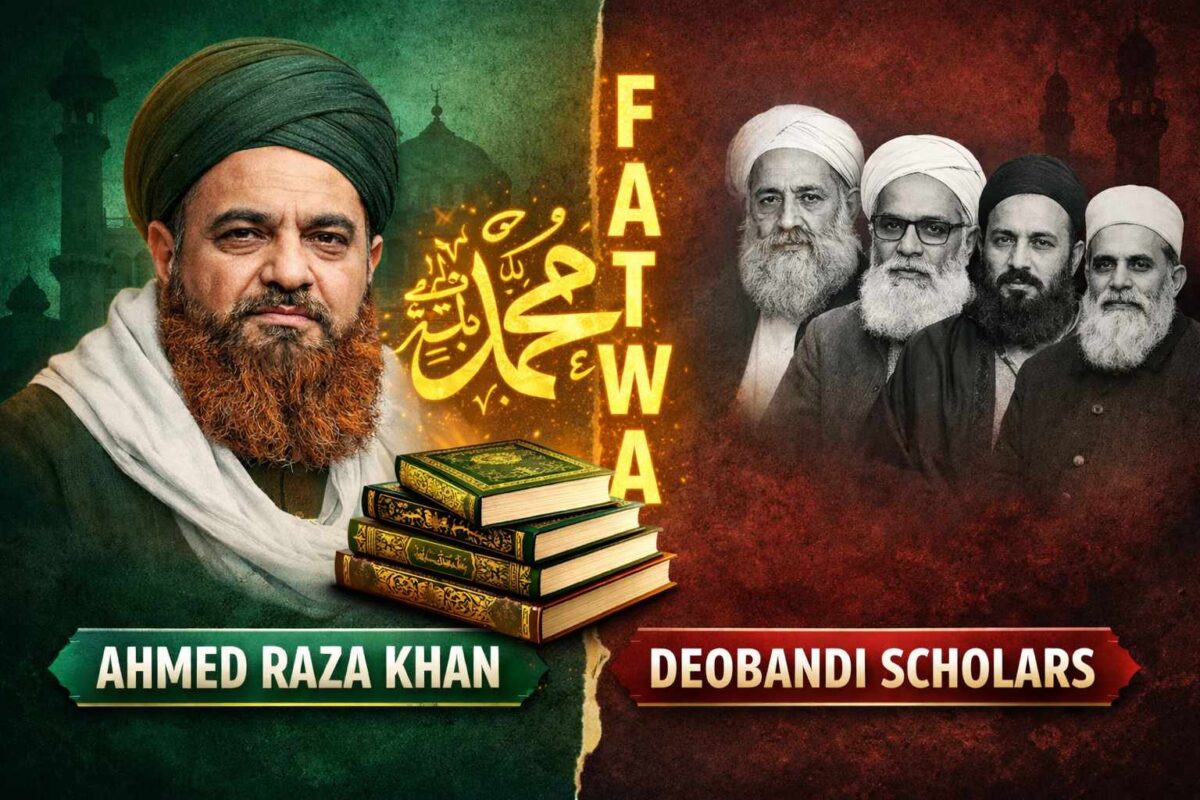
One of the most consequential and historic responses to this concern came from Imam Ahmed Raza Khan al-Qadiri (1856–1921), a towering Hanafi jurist, theologian, and mystic of Bareilly. His detailed legal verdicts (fatawa) on this matter would come to define the red lines of Sunni belief in South Asia and beyond. This article seeks to explain, in an academic and evidence-based manner, what was written, why it was considered theologically dangerous, how the fatwa was issued, and why its judgment was independently verified by the scholars of Mecca and Medina. Crucially, we will place the disputed statements side-by-side with the Qur’an’s explicit commands on the reverence due to the Prophet ﷺ, and then demonstrate how the earliest generations of Muslims—the Sahabah, Tabi‘een, and the four Imams—exemplified these commands in their speech and conduct, thereby exposing the unprecedented nature of the problematic writings.
The Foundational Sunni Principle: Adab of the Prophet ﷺ
In Sunni theology, the Prophet Muhammad ﷺ is not merely a righteous human, a wise teacher, or a spiritual guide among others. He occupies a unique ontological and epistemic rank granted directly by Allah. He is the Final Messenger, the Seal of the Prophets, the Beloved of Allah (Habibullah), and the most honored of all creation. This belief is not a cultural expression of love; it is a core article of faith (Aqeedah) with direct implications for belief and practice.
Core principles derived from classical Sunni scholarship include:
-
Ultimate Honor: The Prophet ﷺ is the most honored creation. Allah says, “And We have exalted your fame” (Qur’an 94:4).
-
Divinely Granted Knowledge: His knowledge, including of the unseen (‘Ilm al-Ghayb), is bestowed by Allah and is incomparable to the limited, acquired knowledge of ordinary humans.
-
Absolute Reverence in Speech: Any statement, explicit or implicit, that reduces his rank, compares him unfavorably, or places him on an equal footing with others is treated with extreme seriousness. In matters of Aqeedah, what is said is judged by its explicit wording (sareeh) and its necessary implication (lazim), not solely by the author’s claimed intention (niyyah). This methodological principle is essential for understanding the gravity of the ensuing controversy.
Part 1: The Problematic Statements – A Verbatim Examination
This was not a dispute over political strategy or minor legal rulings. It centered on specific, written words concerning the Prophet ﷺ. Scholars who objected, led by Imam Ahmed Raza, did not rely on hearsay or paraphrase; they extracted and analyzed verbatim quotations.
1. From Tahdhir-un-Naas by Ismail Dehlvi (d. 1868)
-
The Statement (Summary): “The difference between Prophets and righteous elders (buzurg) is only of rank (martaba); in reality (haqiqatan) they are equal.”
-
Why Scholars Objected: Sunni theology holds that Prophethood (Nubuwwah) is not merely a higher degree of sainthood (Wilayah); it is a distinct reality (haqiqah), a unique covenant with Allah. To state that Prophets and non-Prophets are equal “in reality” collapses this qualitative distinction into a mere quantitative one. It contradicts the Qur’anic principle of the Prophets’ unique election. Even if the author intended to promote humility or combat perceived exaggeration, the wording itself implies doctrinal equivalence, which scholars deemed unacceptable.
2. From Hifz-ul-Iman by Ashraf Ali Thanvi (d. 1943)
-
The Statement (Summary): If knowledge of the unseen (‘Ilm al-Ghayb) is taken in a broad or metaphorical sense, then children, madmen, and animals would also share in it.
-
Why Scholars Objected: The objection was not focused on denying limited unseen knowledge to others, as Allah may grant glimpses to whomever He wills. The critical problem lay in the chosen analogy (tashbeeh). Discussing the Prophet’s ﷺ divinely bestowed knowledge using analogies of children, the insane, and animals was seen as inherently degrading and disrespectful. In Sunni legal and theological principles (Usul), any analogy that lowers the dignity (shaan) of the Prophet ﷺ—even if unintentional—is prohibited. The comparison itself was ruled theologically inappropriate.
3. From Barahin-e-Qati‘a by Khalil Ahmad Saharanpuri (d. 1927)
-
The Statement (Summary): Shaytan (Satan) has knowledge of certain matters that the Messenger of Allah ﷺ does not have.
-
Why Scholars Objected: This statement triggered the strongest reaction. It explicitly compares the knowledge of the accursed Shaytan to that of the Prophet ﷺ, with the necessary implication (lazim) being a deficiency in prophetic knowledge. In Sunni Aqeedah, even the hypothetical suggestion that a cursed being possesses knowledge denied to the Prophet ﷺ is utterly unacceptable. Scholars ruled that such an implication, by necessity of the wording, constitutes explicit blasphemy (kufr), irrespective of any interpretive explanations offered later.
Why These Words Were Judged So Seriously: A critical principle in Islamic theology states: “Al-Kufr yuthbatu bil-lafz al-sareeh wa bil-lazim al-sareeh” (Kufr is established by explicit wording and by explicit necessary implication). Aqeedah is judged by what is publicly said and its unavoidable meaning, not by private intent or post-facto clarifications. Ambiguous or careless wording in matters of the Prophet’s ﷺ status is itself considered blameworthy.
Part 2: The Uncompromising Standard – The Qur’anic Warnings
To understand why traditional scholars reacted with such gravity, one must consult the ultimate standard: the Qur’an itself. Allah did not leave the manner of addressing His Prophet ﷺ to cultural norms or personal discretion; He legislated it with clear, unambiguous commands addressed directly to the believers.
Warning 1: Do Not Raise Your Voices – The Prohibition of Equal Mannerism
يَـٰٓأَيُّهَا ٱلَّذِينَ ءَامَنُوا۟ لَا تَرْفَعُوٓا۟ أَصْوَٰتَكُمْ فَوْقَ صَوْتِ ٱلنَّبِىِّ وَلَا تَجْهَرُوا۟ لَهُۥ بِٱلْقَوْلِ كَجَهْرِ بَعْضِكُمْ لِبَعْضٍ أَن تَحْبَطَ أَعْمَـٰلُكُمْ وَأَنتُمْ لَا تَشْعُرُونَ
“O you who believe! Do not raise your voices above the voice of the Prophet, nor speak loudly to him as you speak loudly to one another, lest your deeds become worthless while you do not even realize.” (Qur’an 49:2)
Reflection: This warning is directed at believers, not hypocrites. The issue is the tone and manner of speech. Merely speaking to the Prophet ﷺ in the same loud, casual tone one uses with peers risks nullifying all one’s deeds—a spiritual catastrophe. If the sound of one’s voice carries such severe consequences, what then of the meaning of one’s words when they diminish his rank or knowledge?
Warning 2: A Single Word is Banned – The Primacy of Reverent Wording
يَـٰٓأَيُّهَا ٱلَّذِينَ ءَامَنُوا۟ لَا تَقُولُوا۟ رَٰعِنَا وَقُولُوا۟ ٱنظُرْنَا وَٱسْمَعُوا۟ ۗ وَلِلْكَـٰفِرِينَ عَذَابٌ أَلِيمٌۭ
“O you who believe! Do not say ‘Rāʿinā’, but say ‘Unẓurnā’, and listen carefully. And for the disbelievers is a painful punishment.” (Qur’an 2:104)
Reflection: Linguistically, “Rāʿinā” could mean “pay attention to us.” However, it had a disrespectful connotation in another language, and the Jews used it mockingly. Allah did not say, “You can say it but mean well.” He forbade the word itself and commanded its replacement with “Unẓurnā.” This establishes a foundational Islamic legal principle: Words matter independently of intent when they touch the dignity of the Prophet ﷺ. An acceptable meaning is rejected if the wording itself can carry disrespect.
Warning 3: Do Not Address Him Like Ordinary People
لَّا تَجْعَلُوا۟ دُعَآءَ ٱلرَّسُولِ بَيْنَكُمْ كَدُعَآءِ بَعْضِكُم بَعْضًۭا
“Do not make your calling of the Messenger among yourselves like the calling of one of you to another…” (Qur’an 24:63)
Reflection: Equality in address is explicitly forbidden. How then can equality in status, rank, or knowledge be permissible? The verse legislates a distinction in form, which points to a foundational distinction in reality.
The Ultimate Proof: How Allah Addresses His Prophet ﷺ
A decisive, often overlooked observation from the Qur’anic text itself:
Allah addresses other noble Prophets by name:
-
“Yā Ādam” (O Adam) – 2:35
-
“Yā Nūḥ” (O Noah) – 11:46
-
“Yā Ibrāhīm” (O Abraham) – 2:124
-
“Yā Mūsā” (O Moses) – 20:19
-
“Yā ʿĪsā” (O Jesus) – 3:55
But when addressing the Prophet Muhammad ﷺ, Allah uses titles of immense honor:
-
“Yā Ayyuhan-Nabī” (O Prophet!) – 8:64
-
“Yā Ayyuhan-Rasūl” (O Messenger!) – 5:41, 67
This is not a coincidence; it is a lesson in adab. If Allah, the Lord of the Worlds, in His infinite wisdom and mercy, chooses to address His Beloved ﷺ with titles of honor rather than by his personal name out of respect, who then has the permission to address him ﷺ with language that levels, compares, or diminishes? This Qur’anic pattern silences any argument for casual or speculative language about the Prophet ﷺ.
Part 3: The Living Example – The Sahabah, Tabi‘een, and Early Imams
The Qur’anic commands were not abstract; they were embodied by the best of generations. Their practice establishes the normative Sunni tradition (‘urf al-salaf) regarding the Prophet’s ﷺ status.
The Sahabah (Companions – رضي الله عنهم):
Their reverence was tangible. They lowered their voices in his presence (implementing 49:2 immediately). They would not stare at him out of awe. They debated fiercely among themselves on legal matters but never on his rank or knowledge. There is zero authentic record of any Sahabi saying, “He is like us in reality,” or “Someone else might know what he does not,” or using analogies of children, madmen, or Satan to discuss his ﷺ attributes. Their disagreements with him ﷺ were rare, respectful, and instantly surrendered to revelation.
The Tabi‘een and Taba‘ Tabi‘een (Successors):
These generations, farther from his physical presence, were more cautious, not less. They feared misrepresenting him ﷺ more than anything. Their principle was caution: guarding the tongue concerning the Prophet ﷺ was more critical than guarding one’s actions. Speculative theology about his nature or knowledge was absent from their discourse.
The Four Great Imams of Sunni Islam:
-
Imam Abu Hanifa (d. 767): He refused to say phrases like “Had it not been for the Prophet ﷺ…” feeling they were insufficiently reverent. He explicitly warned against any wording that implied reduction of the Prophet’s ﷺ status.
-
Imam Malik ibn Anas (d. 795): He would not ride an animal in Madinah out of reverence for the Prophet ﷺ buried there. He said, “How can I raise my voice in a land where the Messenger of Allah ﷺ rests?” Using language that likened the Prophet ﷺ to ordinary beings would have been unthinkable to him.
-
Imam Muhammad ibn Idris al-Shafi‘i (d. 820): He stated, “If a person speaks carelessly about the Messenger ﷺ, he destroys his own religion,” warning against theological speculation involving the Prophet.
-
Imam Ahmad ibn Hanbal (d. 855): He declared, “We do not engage in analogy (qiyas) when speaking about the Messenger ﷺ.” This is pivotal—the very kind of analogical reasoning used in the later problematic statements was preemptively rejected by Imam Ahmad.
The Unbroken Consensus: From the Qur’an to the Sahabah, to the Tabi‘een, to the Four Imams, there is an unbroken chain of consensus: absolute, meticulous reverence in speech concerning the Prophet ﷺ. The statements from 19th-century India had no precedent in this tradition.
Part 4: Imam Ahmed Raza Khan’s Methodological Response
Faced with unprecedented written statements, Imam Ahmed Raza did not act hastily or emotionally.
-
Verbatim Extraction: He based his analysis on exact quotations, not summaries.
-
Classical Usul: He applied established Hanafi and Sunni theological principles—judging by wording and necessary implication (lazim).
-
Distinction: He differentiated between a legal ruling (hukm) on a statement and a judgment on a person’s heart or eternal fate.
-
Seeking Independent Verification: Understanding the gravity of declaring a statement blasphemous (takfir), he did not rely on his own authority. He compiled the evidence and sent it to the most respected, neutral scholars of the Islamic world: the ‘Ulama of the Haramain—Mecca and Medina.
Why the Haramain?
These scholars were:
-
Geographically and politically neutral, far from the subcontinental context.
-
The heirs of classical scholarship, representing the tradition of the Salaf in the two holiest cities.
-
Their agreement would remove any accusation of sectarian or regional bias.
The Verdict from Mecca and Medina
After thorough review, multiple leading scholars of the Haramain, including Sayyid Ahmad Dahlan (Mufti of Mecca) and Shaykh Saleh Kamal, concurred. They affirmed that:
-
The quoted statements did contain blasphemous implications.
-
The ruling of kufr on these statements was juristically sound and correct.
-
The issue was one of textual meaning and creedal boundaries.
This confirmation, compiled in works like Husam al-Haramain, provided an independent, powerful endorsement of the verdict’s doctrinal basis.
Part 5: Conclusion – Words, Meaning, and Unavoidable Implications
This historic episode was never about personality clashes, scholarly jealousy, or political rivalry. It was, at its core, about words, their meanings, and their unavoidable theological implications.
When the problematic statements are placed side-by-side with:
-
The Qur’an’s explicit warnings about voice, word choice, and manner of address,
-
The Sunnah of the Sahabah who embodied these commands,
-
The practice of the early Imams who forbade analogy and speculation,
-
The unprecedented nature of such language in Islamic history,
the conclusion becomes inescapable. The reaction of Imam Ahmed Raza Khan and the verifying scholars of the Haramain was not an overreaction; it was a disciplined, methodological defense of a core, non-negotiable Sunni principle.
Takfir in this context was a legal ruling on specific statements and their implications, not a declaration on individuals’ inner faith or eternal destiny—a distinction Imam Ahmed Raza himself maintained.
The Long-Term Impact: This episode served to:
-
Define and reinforce the red lines of Sunni Aqeedah regarding the Prophet ﷺ.
-
Educate the Muslim public on the critical importance of precision and reverence in theological language.
-
Establish a lasting scholarly reference point for distinguishing between legitimate scholarly disagreement and deviations in foundational belief.
The central lesson, echoing from the Qur’an through the centuries, remains vital today: In matters concerning the Prophet Muhammad ﷺ, caution in speech is not extremism—it is the very essence of faith and adab.
