Quran-93:10 Surah Ad-dhuha English Translation,Transliteration and Tafsir(Tafseer).

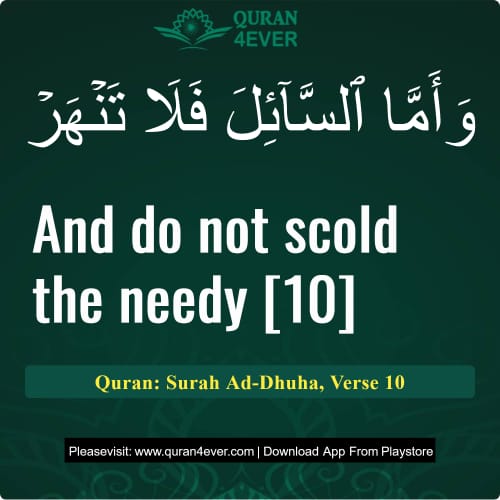
وَأَمَّا ٱلسَّآئِلَ فَلَا تَنۡهَرۡ

Transliteration:( Wa am mas saa-ila fala tanhar )

10. And do not scold the needy [10] (Kanzul Imaan Translation)

(10) And as for the petitioner,[1942] do not repel [him]. (Saheen International Translation)

Related Ayat(Verses)/Topics

Surah Ad-Dhuha Ayat 10 Tafsir (Commentry)


  • Tafseer-e-Naeemi (Ahmad Yaar Khan)
  • Ibn Kathir
  • Ala-Madudi
  • Shaheen International

Tafseer (Commentary) of the Verse

"And do not scold the needy"

This verse reminds us of the importance of treating the needy with respect and compassion. It also highlights the different types of bounties Allah Almighty has granted His Beloved Prophet ﷺ, reflecting Allah's infinite generosity.


Types of Bounties Bestowed Upon the Holy Prophet ﷺ

1. Visible Bounties

  • These are blessings that have been openly declared and recognized by all.
  • Examples include:
    • Prophethood: The greatest visible bounty, serving as the foundation of faith for humanity.
    • Intercession: A vital aspect of salvation for believers on the Day of Judgment.
  • Faith in these bounties is essential for belief.

2. Concealed Bounties

  • These blessings are hidden but can be revealed in specific circumstances.
  • Through recognizing these bounties, people gain a deeper mystical understanding of Allah Almighty and His Divine Wisdom.

3. Exclusive Bounties

  • These are the most special and secret blessings, reserved for the Holy Prophet ﷺ alone.
  • They are part of the Divine Mysteries and remain unrevealed.
  • Allah Almighty says:
    • "Now He revealed to His bondsman whatever He revealed" (Surah An-Najm: Verse 10).
    • This verse refers to the exclusive bounty that Allah alone knows and has given uniquely to His Beloved Prophet ﷺ.

Reflection on the Verse

  • The prohibition against scolding the needy reminds believers of the Prophet’s character as Rahmatul-lil-Alameen (Mercy to the Worlds).
  • Just as Allah has bestowed bounties upon the Holy Prophet ﷺ out of His mercy and generosity, we too must extend kindness and generosity to those in need.
  • Scolding or mistreating the needy is not only a violation of their dignity but also a failure to embody the teachings and example of the Holy Prophet ﷺ.

Ibn-Kathir

The tafsir of Surah Ad-Duha verse 10 by Ibn Kathir is unavailable here.
Please refer to Surah Ad-Duha ayat 1 which provides the complete commentary from verse 1 through 11.


Ala-Maududi

(93:10) and chide not him who asks,[10]


10. It has two meanings.

If saail is taken in the sense of aneedy person, who asks for help, it would mean that if youcan, you should help him. If you cannot, you should excuseyourself politely, but should never scold him. In this sensethe instruction corresponds to Allah’s this favor: You werepoor, then Allah enriched you.

And if saail is taken in thesense of the one who inquires, i.e. asks for enlightenment ona religious matter or injunction, it would mean that even ifsuch a person be extremely ignorant and ill-mannered andmight put the question, or present his problem, impolitely,you should in any case answer him politely and kindly, andshould not turn him away like the rude people proud oftheir knowledge.

In this meaning, the instructioncorresponds to Allah’s this favor: You were unaware of theway, then He guided you. Abu Darda, Hasan Basri, SufyanThauri and some other scholars have preferred this secondmeaning, for in view of the order and sequence thisinstruction corresponds to: wa-wa-jadaka daalllan fa hada.

(10) And as for the petitioner,[1942] do not repel [him].

[1942]- Anyone who seeks aid or knowledge.

Surah Ad-Dhuha All Ayat (Verses)

1
2
3
4
5
6
7
8
9
10
11
Quran Surah 93 Verse 10

Sign up for Newsletter

×

📱 Download Our Quran App

For a faster and smoother experience,
install our mobile app now.

Download Now