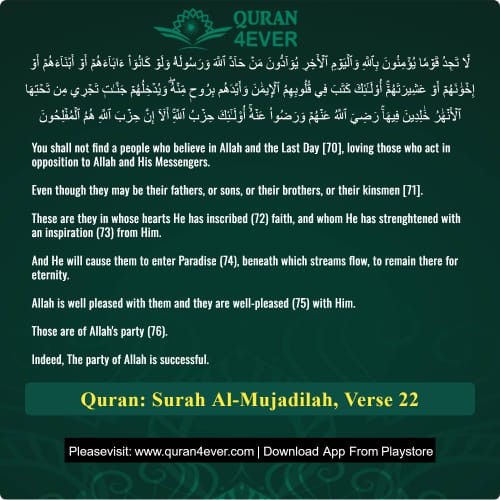
Transliteration:( Laa tajidu qawmany yu'minoona billaahi wal yawmil aakhiri yuwaaaddoona man haaaddal laaha wa Rasoolahoo wa law kaanooo aabaaa'ahum aw abnaaa'ahum aw ikhwaa nahum aw 'asheeratahum; ulaaa'ika kataba fee quloobihi mul eemaana wa ayyadahum biroohimminhu wa yudkhilu hum jannatin tajree min tahtihal anhaaru khaalideena feehaa; radiyal laahu 'anhum wa radoo 'anhu; ulaaa 'ika hizbul laah; alaaa inna hizbal laahi humul muflihoon )
“You shall not find a people who believe in Allah and the Last Day [70], loving those who act in opposition to Allah and His Messengers. Even though they may be their fathers, or sons, or their brothers, or their kinsmen [71]. These are they in whose hearts He has inscribed [72] faith, and whom He has strengthened with an inspiration [73] from Him. And He will cause them to enter Paradise [74], beneath which streams flow, to remain there for eternity. Allah is well pleased with them and they are well-pleased [75] with Him. Those are of Allah's party [76]. Indeed, the party of Allah is successful.”
This means belief not only in Allah and the Last Day but also in everything connected to faith.
The word “few” includes all true believers, indicating a rare and sincere quality in such people.
This means the sign of a perfect believer is that his heart never inclines towards the disbelievers,
nor does he maintain any friendship or emotional attachment with them.
Even if their parents, children, or siblings are disbelievers,
they hold no love for them in their hearts—because love for Allah
removes all room for the love of His enemies.
As a poet said:
"Thousands of relatives become strangers through attachment with Allah.
Love for One expels from the heart love for everything else."
May Allah grant us such perfect faith. Aameen.
The lives of the Noble Companions are the perfect, living commentary of this verse. For example:
In the Battle of Uhud, Hazrat Abu Ubaidah ibn Jarrah killed his father Jarrah.
In Badr, Hazrat Ali Murtaza killed Utbah ibn Rabeeah,
Hazrat Umar killed his maternal uncle Aas ibn Hisham,
and Mus’ab ibn Umair killed his brother Abdullah ibn Umair.
Hazrat Abu Bakr Siddiq once called his son Abdur Rahman to a duel,
but the Holy Prophet ﷺ stopped him.
Later, Abdur Rahman accepted Islam.
These incidents are a powerful expression of the verse’s message.
By “spirit” is meant either:
The Holy Qur’an,
Hazrat Jibra’eel (عليه السلام),
Or divine help from unseen sources.
Note: Hardships that come upon the Companions and believers are not against this verse.
Such difficulties:
Atone for sins in the sinful,
And elevate ranks of the pious.
For example, a plague is a punishment for disbelievers,
but a mercy for believers,
and the ability to bear it with patience is a form of divine support.
The reward in this world is that Allah will guide them to steadfastness in faith.
Just as deep engravings on a coin don’t fade, their faith remains unshaken.
In the Hereafter, their reward is that:
Allah will be theirs,
And they will belong to Him.
When Allah becomes theirs, so does Paradise and all its bounties.
May Allah Almighty grant us this eternal closeness. Aameen.
From this, two points emerge:
Gaining Allah’s pleasure is the greatest bounty, which only a few attain.
The pious, whether Companions, saints, or righteous scholars,
may be addressed with “Radi Allahu ‘Anhu”—“May Allah be pleased with him.”
As Allah says (Surah 98:8):
“Allah is well pleased with them and they are pleased with Allah.”
He who fears Allah, is pleased with Him, and Allah is pleased with him.
This tells us that:
The Noble Companions are Allah’s party,
And all those who attach themselves to them until the Day of Judgment
are also part of Allah’s group.
Those who detach from them fall into the party of Shaitaan.
The tafsir of Surah Mujadilah verse 22 by Ibn Kathir is unavailable here.
Please refer to Surah Mujadilah ayat 20 which provides the complete commentary from verse 20 through 22.
(58:22) You shall not find a people who believe in Allah and the Last Day befriending those who oppose Allah and His Messenger even though they be their fathers or their sons or their brothers or their kindred.[37] He has inscribed faith in their hearts and has strengthened them with a spirit from Him, and He shall make them enter Gardens beneath which rivers flow. Therein they shall abide. Allah is well-pleased with them, and they are well-pleased with Him. They belong to Allah’s party. Verily Allah’s party shall prosper.
37. Two things have been stated in this verse: first, a matter of principle, and the second, a statement of fact. The matter of principle is that faith in the true religion and love of the opponents of the religion are contradictory things, which cannot conceivably co-exist in one and the same place. It is absolutely impossible that love of the faith and love of the enemies of Allah and His Messenger (peace be upon him) should co-exist in one and the same heart, just as a person’s love for himself and his love for his enemy cannot co-exist in his heart simultaneously This is as if to say: lf you see a person who professes the faith as well as keeps relations of love with the opponents of Islam, you should never be involved in the misunderstanding that he might perhaps be true in his profession in spite of his this attitude and conduct. Likewise, the people who have established relations with Islam and the opponents of Islam simultaneously, should themselves also consider their position well and see what they actually are. Are they believers or hypocrites? And what actually they want to be. Do they want to live as believers or as hypocrites? If they have any righteousness left in them and any feeling that from a moral viewpoint hypocrisy is the meanest and most abject attitude for man, they should give up their attempt to ride in two boats simultaneously. Faith wants them to be decisive. If they want to remain believers, they should sever and sacrifice all those connections that clash with their relationship with Islam. If they hold another relation dearer to themselves than the relationship with Islam, then they should better give up their false profession of Islam.
Here, Allah has not just stated the principle but has also presented the fact as a model before those who professed the faith. The true believers had in fact severed all connections that clashed with their relationship with Allah’s religion. This had been witnessed by entire Arabia in the battles of Badr and Uhud. The emigrants from Makkah had fought against their own tribe and closest kinsmen only for the sake of Allah and His religion. Abu Ubaidah killed his father, Abdullah bin al-jarrah. Musab bin Umair killed his brother, Ubaid bin Umair. Umar killed his maternal uncle, Aas bin Hisham bin Mughirah. Abu Bakr became ready to fight his son, Abdur Rahman. Ali, Hamzah and Ubaidah bin al-Harith killed Utbah, Shaibah and Walid bin Utbah, who were their close kinsmen. About the prisoners of war captured at Badr, Umar gave the opinion that they should all be put to the sword, and proposed that a relative should kill a relative. In the same battle of Badr when Musab bin Umair saw that an Ansari Muslim had captured his real brother, Abu Aziz bin Umair, and was tying him, he shouted out to him, saying: Tie him tight: his mother is a rich woman. She will pay you a large ransom. Abu Aziz said: You are a brother and say this. Musab replied: Not you, but this Ansari Muslim is my brother now who has captured you. In the same battle of Badr, Abul Aas the son-in-law of the Prophet (peace be upon him) was taken as a prisoner and was shown no special favor any different from the other prisoners on account of his relationship with the Prophet (peace be upon him). Thus, the world was made a witness to the fact and shown the character of the sincere Muslims and their profound relationship with Allah and His Messenger (peace be upon him).
Dailami has related this invocation of the Prophet (peace be upon him) on the authority of Muadh: Alla-humma la taj al li-fajir-in (and according to another tradition, il-fasiq-in) alayya yadan wa la ni mata fa yuwadda-hu qalbi fa-inni wajad-tu fima uhitu ilayya la tajidu qaum-an yu minuna billahi wal-yaum il-akhir-i yuwaaddiuaa man haadd-Allahs wa Rasulahu: O God, let not the wicked (and according to another tradition, the sinful) do me a favor because of which I may have love for him in my heart, for in the revelation sent down by You, I have also found this: You will never find any people who believe in Allah and the Last Day loving those who oppose Allah and His Messenger (peace be upon him).
[1648]- i.e., "that which gives life," explained as the guidance of the Qur’ān or victory over their opponents.
For a faster and smoother experience,
install our mobile app now.
Related Ayat(Verses)/Topics