Transliteration:( Ulaaa'ikal lazeena nata qabbalu 'anhum ahsana maa 'amiloo wa natajaawazu 'an saiyiaatihim feee Ashaabil jannati Wa'das sidqil lazee kaanoo yoo'adoon )
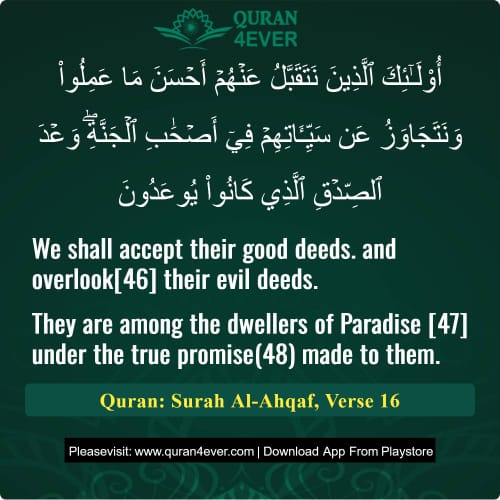
We shall accept their good deeds and overlook [46] their evil deeds. They are among the dwellers of Paradise [47] under the true promise [48] made to them.
This refers to the sins committed before embracing Islam. In the case of Hazrat Abu Bakr Siddiq (RA), Allah Almighty had protected him even before Islam from all major sins such as shirk (polytheism), adultery, and intoxicants. Thus, he entered Islam in a state of purity, and his past was already free from major wrongdoing.
This verse explicitly affirms that Abu Bakr Siddiq (RA) is among the people of Paradise, a promise already granted by Allah Almighty. Therefore, doubting his faith, piety, or status is equivalent to rejecting the truth of this verse.
Reflect on this example: the dog that accompanied the People of the Cave was honoured due to its association with pious ones and will enter Paradise. Then how much greater must be the honour of the one who sat in the cave beside the Prophet ﷺ, cradling the Qur’an's bearer on his lap? Such companionship is beyond imagination in reward and status.
The true promise refers to the glad tidings given by the Holy Prophet ﷺ to Abu Bakr Siddiq (RA) during his lifetime—that he would be his companion in Paradise, just as he was in the Cave. Moreover, he was granted the immense honour of being buried beside the Prophet ﷺ in his blessed chamber—a living sign of the eternal companionship promised in the Hereafter.
The tafsir of Surah Ahqaf verse 16 by Ibn Kathir is unavailable here.
Please refer to Surah Ahqaf ayat 15 which provides the complete commentary from verse 15 through 16.
(46:16) Such are those from whom We accept their best deeds and whose evil deeds We overlook.[21] They will be among the people of Paradise in consonance with the true promise made to them.
21. That is, their ranks in the Hereafter will be determined by the best deeds they would have done in the world, and their lapses and weaknesses and errors will be overlooked. It is just like a generous and appreciative master who determines the worth of his loyal and obedient servant not by the petty services that he renders but by some work of merit that he might accomplish or a feat of devotion and dedication that he might perform. He will not call his servant to account for his minor shortcomings and overlook his major services.
For a faster and smoother experience,
install our mobile app now.
Related Ayat(Verses)/Topics