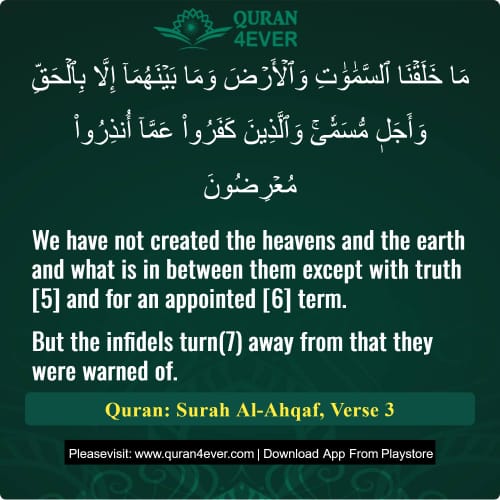
Transliteration:( Maa khalaqnas samaawaati wal arda wa maa bainahumaaa illaa bilhaqqi wa ajalim musammaa; wallazeena kafaroo 'ammaaa unziroo mu'ridoon )
We have not created the heavens and the earth and what is in between them except with truth [5] and for an appointed [6] term. But the infidels turn [7] away from that they were warned of.
Like the region, fire, air, cloud, rain, and other atmospheric creations. In short, the entire physical world is included in this. Since we primarily experience this world, it is specifically mentioned here. However, the world of light, the world of command, and others are also creations of Allah Almighty. Here, the word "truth" denotes wisdom and Divine purpose.
There are also signs of Divine power in these creations—Allah Almighty’s wisdoms and symbols are reflected within them. Therefore, truth here does not mean eternity, since everything created has an end. This verse does not contradict the Hadith: "Allah is Truth; everything else is false", because in that context, truth affirms Divine necessity, while all creation is temporary.
By appointed term, it refers to the end of these creations, which is known only to Allah Almighty. It may also refer to the Day of Judgement, on which everything will perish. Alternatively, it could apply to any definite religious truth—rejecting which amounts to infidelity.
This part of the verse points to the disbelievers’ rejection of the warnings—such as punishment in the grave and the Day of Judgement [8]. Despite clear signs and reminders, they turn away from the very things they were warned about.
The tafsir of Surah Ahqaf verse 3 by Ibn Kathir is unavailable here.
Please refer to Surah Ahqaf ayat 1 which provides the complete commentary from verse 1 through 6.
(46:3) We have created the heavens and the earth and all that is between them in Truth and for an appointed term.[2] But those who disbelieve have turned away from what they were warned against.[3]
2. For explanation, see (Surah Al-Anaam, Ayat 73); (Surah Younus, Ayat 5-6); (Surah Ibrahim, Ayat 19); (Surah Al-Hijr, Ayat 85); (Surah An-Nahl, Ayat: 3); (Surah Al-Anbiya, Ayat 16-18); (Surah Al-Muminun, Ayat 115); (Surah Al-Ankabut, Ayat 44); (Surah Ar-Room, Ayat 8).
3. That is, the fact is that this universe is not a purposeless plaything but a purposeful, wise system in which the decisions regarding the good and the bad, the oppressor and the oppressed, will necessarily be based on justice. The present system of the universe is not permanent and eternal, but it has a fixed term appointed for it on the expiry of which it will inevitably come to an end. For the court of Allah also there is a settled time and it will certainly be established when the time for it reaches its term. But the people who have refused to believe in Allah’s Prophet (peace be upon him) and His Book, have an aversion to these truths. They are least mindful of this that a time has to come when they will have to render an account of their deeds. They think that the Messenger (peace be upon him) of Allah has done them a great wrong by warning them of these truths, whereas he has done them a great good by fore-warning them not only of the time when they will be subjected to accountability but also of what they will be questioned at that time so that they may prepare themselves accordingly.
To understand the following discourse it should be borne in mind that man’s basic error is the one that he commits with regard to determining his belief about God. In this regard, the adoption of a creed carelessly on the basis of mere hearsay, without any serious and deep thought and investigation is a stupendous folly, which vitiates man’s entire attitude towards life in the world and ruins his destiny for ever afterwards. But the reason why man becomes involved in this dangerous kind of heedlessness is that he regards himself as irresponsible and un-answerable and develops the misunderstanding that whatever creed he may adopt about God, it would make no difference, because either there is no life after death in which he might have to face accountability, or if there is any such life and he is also called to account, the beings of whom he is a devotee, will save him from any evil fate. This same lack of the sense of responsibility renders him frivolous in the selection of a religious creed, and on the basis of the same he fabricates all sorts of absurd creeds, from atheism to every form of polytheism, or adopts the creeds fabricated by others.
For a faster and smoother experience,
install our mobile app now.
Related Ayat(Verses)/Topics