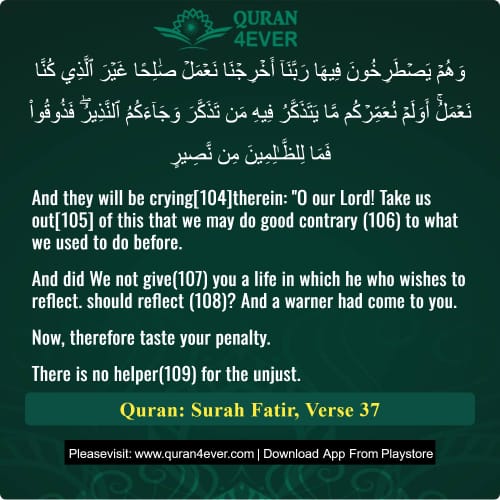
Transliteration:( Wa hum yastarikhoona feehaa Rabbanaa akhrijnaa na’mal saalihan ghairal lazee kunnaa na’mal; awa lamnu ‘ammirkum maa yatazak karu feehi man tazakkara wa jaaa’akumun nazeeru fazooqoo famaa lizzaalimeena min naseer (section 4) )
"And they will be crying [104] therein: 'O our Lord! Take us out [105] of this that we may do good contrary [106] to what we used to do before.' And did We not give [107] you a life in which he who wishes to reflect, should reflect [108]? And a warner had come to you. Now, therefore taste your penalty. There is no helper [109] for the unjust."
In Hell, they will scream, wail, and plead. Sometimes they will complain to the gatekeepers, sometimes to Allah Almighty, at other times rebuke one another. Their cries will echo with remorse and desperation.
They will beg to be sent back to the world, claiming they would now act differently. But there is no realm of deeds besides the world. As for sinful believers, they will eventually be taken out of Hell and admitted to Paradise, but no such respite will be granted to infidels.
Their desire is not only to change their external actions, but also to rectify their inner intentions and beliefs. However, this request will be rejected.
Many scholars derive from this that minor children of infidels will not go to Hell, since they were never given the chance to reflect or choose. Hence, they will be admitted into Paradise.
This implies that those who lived by natural disposition (fitrah) and to whom no Prophet was sent, may also be excused from Hell. Belief in the Oneness of Allah may be enough for their salvation.
Unjust here means disbelievers. They will find no helper or intercessor on the Day of Judgement. In contrast, believers will have many intercessors and helpers granted by Allah Almighty.
The tafsir of Surah Fatir verse 37 by Ibn Kathir is unavailable here.
Please refer to Surah Fatir ayat 36 which provides the complete commentary from verse 36 through 37.
(35:37) They will cry out in Hell and say: “Our Lord, let us out so that we may act righteously, different from what we did before.” (They will be told): “Did we not grant you an age long enough for anyone to take heed if he had wanted to take heed?[63]Besides, there came a warner to you. So have a taste of the torment now. None may come to the help of the wrong-doers.”
63. This implies every such age of life in which a person may be able to distinguish between good and evil, truth and falsehood, if he likes to, and turn to right guidance instead of deviation, if he wishes. If a person has died before attaining such an age, he will not be called to any account according to this verse. However, the one who has attained this age will certainly be held answerable for his actions. Then, as long as he lives after attaining this age and gets more and more opportunities for choosing and adopting the right path, his responsibility also will increase accordingly; so much so that the one who does not adopt right guidance even in old age will have no chance left for making any excuse. This same thing has been reported by Abu Hurairah and Sahl bin Saad as-Saidi in a Hadith, saying: The one who lives a short life has an excuse to offer, but there is no room for making an excuse for him who lives for 60 years or more.” (Bukhari Ahmad, Nasai, Ibn Jarir, Ibn Abi Hatim).
[1253]- The implication is "Return us to the previous world."
For a faster and smoother experience,
install our mobile app now.
Related Ayat(Verses)/Topics