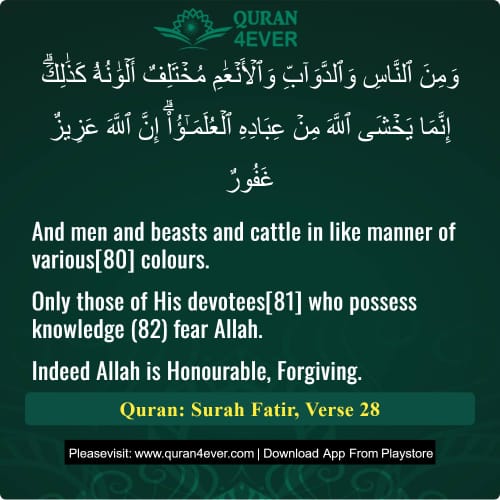
Transliteration:( Wa mina al-nāsi wa al-dawābbi wa al-anʿāmi mukhtalifun alwānuhū kadhālik; innamā yakhshā Allāha min ʿibādihī al-ʿulamāʾ; inna Allāha ʿAzīzun Ghafūr )
"And men and beasts and cattle in like manner of various [80] colours. Only those of His devotees [81] who possess knowledge [82] fear Allah. Indeed Allah is Honourable, Forgiving."
This means human beings, animals, and cattle come in various colours, reflecting the immense power of Allah Almighty. Just as outer appearances differ, hearts too differ in purity. On the Day of Judgement, the inner states of hearts will manifest in the form of luminous or darkened faces—the believers radiant, and the disbelievers darkened.
Here, “devotees” (bondsmen) could refer to the entire creation, or more specifically to human beings, depending on the context.
From this verse we learn that religious scholars hold great honour and dignity. Allah has placed His awe and fear in their hearts. The true scholars are those who possess knowledge of religion and act upon it. The term “ʿUlamāʾ” (men of knowledge) here refers only to those with correct belief and righteous deeds.
The tafsir of Surah Fatir verse 28 by Ibn Kathir is unavailable here.
Please refer to Surah Fatir ayat 27 which provides the complete commentary from verse 27 through 28.
(35:28) and human beings too, and beasts, and cattle diverse are their hues.[48]From among His servants, it is only those who know that fear Allah.[49] Verily Allah is Most Mighty, Most Forgiving.[50]
48. This is meant to impress that in the universe created by Allah nowhere is there homogeneity and uniformity; there is variety everywhere. From the same earth and by the same water different kinds of trees are appearing. Even the two pieces of the fruit of the same tree are not uniform in color and size and taste. In the same mountain one will see a variety of colors and a great difference in the material composition of its different parts. Even among human beings and animals one will not see two offspring of the same parents exactly alike. If a person seeks uniformity of the temperaments and dispositions and mentalities in this universe and is bewildered at the differences which have been alluded to in (Surah Fatir, ayat 19-22) above, it will be his own perception and understanding to blame. This same variety and difference, in fact, point to the reality that this universe has been created by a Wise Being with great wisdom; its Maker is a Unique Creator and a Matchless Fashioner, Who does not have the same model of everything before Him, but has a variety of countless and limitless designs of everything. Then if one ponders over the differences in human temperaments and minds, in particular, one will see that it is not a mere accident, but in fact the masterpiece of the wisdom of creation. If all human beings had been created with the uniform temperaments and desires and feelings and inclinations and ways of thinking, and no room had been left for any difference, it would have been absolutely useless to bring about a new creation like man in the world. When the Creator decided to bring into existence a responsible creation, a creation having power and authority, the necessary inevitable demand of the nature of the decision was that room for all sorts of differences should be provided in its nature and structure. This is the main proof of the fact that the creation of man is not the result of an accident, but the result of a wonderful and wise plan and design. And obviously, wherever there is a wise plan and design, there must necessarily be a Wise Being working behind it, for the existence of wisdom without a Wise Being would be un-imaginable.
49. That is, the more a person is unaware of the attributes of Allah, the more he will be fearless of Him. Contrary to this, the more a person is aware and conscious of Allah’s powers, His knowledge, His wisdom, His vengeance and His omnipotence and His other attributes, the more he will fear His disobedience. Thus, in fact, knowledge in this verse does not imply knowledge of academic subjects like philosophy and science and history and mathematics, etc. but the knowledge of divine attributes, no matter whether one is literate or illiterate. The one who is fearless of God is illiterate merely as regards to this knowledge even if he has all the knowledge of the world. And the one who knows the attributes of God and fears Him in his heart, is learned even if he is illiterate. In the same connection, one should also know that in this verse the ulama does not imply the scholars in the technical sense, who are termed as religious scholars because of their knowledge of the Quran and Hadith and Fiqh and philosophy. They will prove true to this verse only when they possess fear of God in their hearts. The same thing has been said by Abdullah bin Masud, thus: Knowledge is not due to much narration of Hadith but due to much fear of Allah. And also by Hassan Basri, thus: The scholar is he who fears Allah though he has not seen Him, and turns to what is approved by Him and keeps away from what makes Him angry.
50. That is, He is All-Mighty, and therefore, can seize the disobedient as and when He likes: no one can escape His grasp. But He is All-Forgiving also and is, therefore, giving respite to the wrongdoers.
For a faster and smoother experience,
install our mobile app now.
Related Ayat(Verses)/Topics