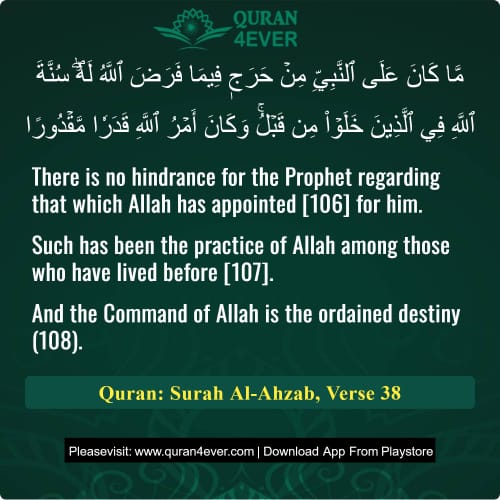
Transliteration:( Maa kaana 'alan nabiyyyi min harajin feemaa faradal laahu lahoo sunnatal laahi fil lazeena khalaw min qabl; wa kaana amrul laahi qadaram maqdooraa )
"There is no hindrance for the Prophet regarding that which Allah has appointed [106] for him. Such has been the practice of Allah among those who have lived before [107]. And the Command of Allah is the ordained destiny [108]."
This means: O My Beloved! Do not be distressed by the taunts of the people. Whatever Allah Almighty has made lawful for you, no one has the right to question or object to it. The Prophet ﷺ only followed the command of Allah; his marriage to Hazrat Zainab was not a personal act, but a divine obligation intended to break false customs and reveal Islamic rulings.
In response to objections—particularly from the Jews and Christians, who questioned why the Prophet ﷺ had more than four wives—it is clarified that Prophets have distinct divine laws. For instance:
Hazrat Dawood (عليه السلام) had 100 wives
Hazrat Sulaiman (عليه السلام) had 300 wives
These examples prove that Prophets were exceptions to certain general laws, and no nation ever objected to this historically. Even the polytheistic religions, like those of the Aryans and Hindus, acknowledge figures with numerous wives.
The marriages of Prophets are by divine command, filled with deep wisdom and purpose—often for the spreading of Islam, the unification of tribes, or to establish important rulings.
The verse emphasizes that Allah’s command is predestined and unchangeable, and whatever the Prophet ﷺ does under divine instruction is beyond human dispute.
38. There is no blame on the Prophet in that which Allah has made legal for him. That has been Allah’s way with those who have passed away of old. And the command of Allah is a decree determined.
(There is no blame on the Prophet in that which Allah has made legal for him.) means, in that which has been permitted for him and which he has been commanded to do, i.e. his marrying Zaynab, may Allah be pleased with her,, who had been divorced by his adopted son Zayd bin Harithah,
(That has been Allah’s way with those who have passed away of old.) means this is the ruling of Allah for the Prophets who came before him. Allah would not command them to do anything for which they might be blamed. This is a refutation of those hypocrites who imagined that there was anything wrong with his marrying the ex-wife of Zayd, his freed slave and adopted son.
(And the command of Allah is a decree determined.) means, His command which He has decreed must inevitably come to pass; nothing can prevent it or avert it, for whatever He wills happens, and whatever He does not decree, does not happen.
(33:38) There could be no hindrance to the Prophet regarding what Allah ordained for him.[74] Such has been Allah’s Way (with the Prophets) who went before. Allah’s command is a decree firmly determined.[75]
74. These words show that for the other Muslims such a marriage is just permissible but for the Prophet (peace be upon him) it was a duty which Allah had imposed on him.
75. That is, for the Prophets it has always been a law that whatever command they receive from Allah, they have to act on it as a duty which they cannot in any case avoid. When Allah enjoins something on His Prophet (peace be upon him), he has to accomplish it even if the entire world is deadly opposed to it.
[1202]- Or permitted to him.
For a faster and smoother experience,
install our mobile app now.
Related Ayat(Verses)/Topics