Transliteration:( Yaa nisaaa'an Nabiyyi mai yaati minkunna bifaa hishatim mubaiyinatiny yudaa'af lahal 'azaabu di'fain wa kaana zaalika 'alal laahi yaseera (End Juz 21) )
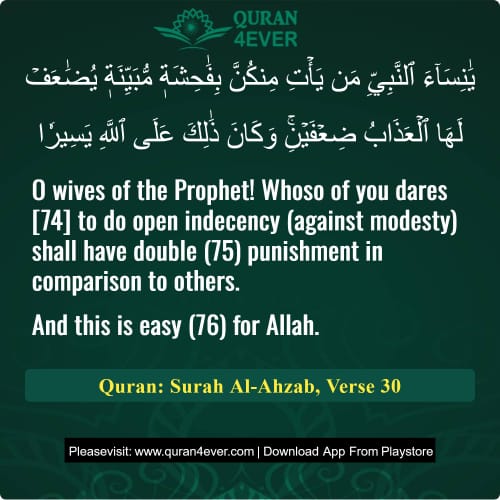
"O wives of the Prophet! Whoso of you dares [74] to do open indecency (against modesty) shall have double [75] punishment in comparison to others. And this is easy [76] for Allah."
The phrase "against manifest modesty" here specifically refers to disobedience to the husband, particularly grave sins such as adultery or sodomy. This is distinguished from common sins, which are considered lesser forms of immodesty.
The wives of the Prophet ﷺ hold a higher status than all other women, and thus the punishment for sinning openly among them is double that of others. This is because the blessings and bounties Allah bestows upon them are greater, and so their accountability is also more severe. This also invalidates any misinterpretations by groups like the Rafzis who try to justify erroneous beliefs from this verse.
Allah has the absolute power to enforce this increased punishment easily. The greater severity of punishment on those of higher status is a reflection of Allah’s justice and mercy, encouraging them—and all believers—to strive earnestly to avoid sin.
30. O wives of the Prophet! Whoever of you commits an open Fahishah, the torment for her will be doubled, and that is ever easy for Allah. 31. And whosoever of you is obedient to Allah and His Messenger, and does righteous good deeds, We shall give her, her reward twice over, and We have prepared for her a noble provision.
This Ayah is addressed to the wives of the Prophet who chose Allah and His Messenger and the Home of the Hereafter, and remained married to the Messenger of Allah . Thus it was befitting that there should be rulings which applied only to them, and not to other women, in the event that any of them should commit open Fahishah. Ibn `Abbas, may Allah be pleased with him, said: “This means Nushuz (rebellion) and a bad attitude.” Whatever the case, this is a conditional phrase and it does not imply that what is referred to would actually happen. This is like the Ayat:
(And indeed it has been revealed to you, as it was to those before you: “If you join others in worship with Allah, surely your deeds will be in vain.”) (39:65)
(But if they had joined in worship others with Allah, all that they used to do would have been of no benefit to them.) (6:88)
(Say: “If the Most Gracious had a son, then I am the first of (Allah’s) worshippers.”) (43:81)
(Had Allah willed to take a son, He could have chosen whom He willed out of those whom He created. But glory be to Him! He is Allah, the One, the Irresistible.) (39:4). Because their status is so high, it is appropriate to state that the sin, if they were to commit it, would be so much worse, so as to protect them and their Hijab. Allah says:
(Whoever of you commits an open Fahishah, the torment for her will be doubled,) Malik narrated from Zayd bin Aslam:
(the torment for her will be doubled,) “In this world and the next.” Something similar was narrated from Ibn Abi Najih, from Mujahid.
(and that is ever easy for Allah.) it is very easy indeed. Then Allah mentions His justice and His bounty, in the Ayah:
(And whosoever of you is obedient to Allah and His Messenger,) i.e., obeys Allah and His Messenger ,
(We shall give her, her reward twice over, and We have prepared for her a noble provision.) i.e., in Paradise, for they will be in the dwellings of the Messenger of Allah in the highest reaches of `Illiyin, above the dwellings of all the people, in Al-Wasilah which is the closest of the dwellings of Paradise to the Throne.
(33:30) Wives of the Prophet, if any of you commit flagrant indecency, her chastisement shall be doubled.[43] That is easy for Allah.[44]
43. This does not mean that there was, God forbid, any chance of the Prophet’s (peace be upon him) wives committing an indecency, but this was meant to make them realize that they were the mothers of the Muslims; therefore, their responsibilities were accordingly very high, and so their moral conduct should be the purest. This is just like Allah’s addressing the Prophet (peace be upon him) to the effect: “If you committed shirk, all your deeds would be rendered vain.” (Surah Az-Zumar, Ayat 65). This also does not mean that there was, God forbid, any chance of the Prophet’s (peace be upon him) committing shirk, but this is meant to make the Prophet (peace be upon him) realize, and through him the common Muslims, that shirk, is a most heinous crime which must be guarded against most judiciously.
44. That is, “You should not be under the delusion that your being the Prophet’s (peace be upon him) wives will protect you from Allah’s punishment, or that it will be difficult for Allah to call you to account on account of your high rank and position in the world.”
For a faster and smoother experience,
install our mobile app now.
Related Ayat(Verses)/Topics