Transliteration:( Fa il lam tajidoo feehaaa ahadan falaa tadkhuloohaa hattaa yu'zana lakum wa in qeela lakumurji'oo farji'oo huwa azkaa lakum; wallaahu bimaa ta'maloona 'Aleem )
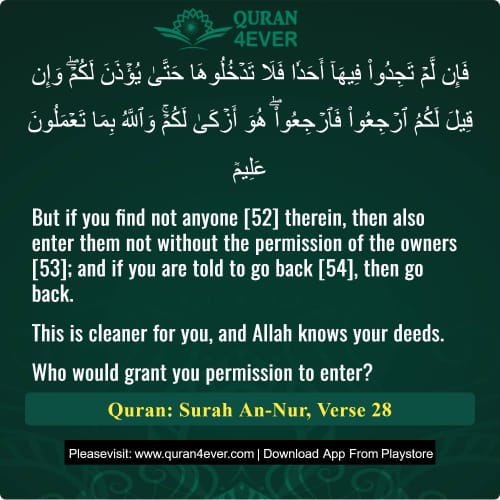
“But if you find not anyone [52] therein, then also enter them not without the permission of the owners [53]; and if you are told to go back [54], then go back. This is cleaner for you, and Allah knows your deeds.”
This part of the verse addresses a situation where a person comes to a house but finds no one inside. Even in such cases, the rule remains:
Do not enter unless explicit permission is granted.
Just because a house appears vacant doesn't entitle someone to enter. The principle of privacy and ownership still applies, reinforcing the sanctity of personal space.
If someone other than the actual owner or resident is present, their permission may not suffice. The verse emphasizes:
Permission must be from those who rightfully control the property.
This instruction upholds not only privacy but also property rights, affirming that even relatives or acquaintances cannot bypass this rule.
If the residents decline your request or ask you to go back, then you are obligated to leave respectfully — without annoyance, resentment, or insistence.
Allah says:
“This is cleaner for you…”
This reflects both outer politeness and inner spiritual cleanliness — avoiding arrogance, suspicion, or intrusion.
The closing words, “Allah knows your deeds,” remind us that even our manners and intentions are under divine observation.
The rhetorical sentence — “Who would grant you permission to enter?” — serves as a warning and moral check:
Entry without consent is an act of violation, and it is Allah-given manners that define the believer’s character.
The tafsir of Surah An-Nur verse 28 by Ibn Kathir is unavailable here.
Please refer to Surah Nur ayat 27 which provides the complete commentary from verse 27 through 29.
(24:28) Then if you find no one in them, do not enter until you have been given permission (to enter).[26] And if you are told to go back, then do go back. This is a purer way for you.[27] Allah knows all what you do.
26. Entry into an empty house is not allowed unless permitted as such by the master of the house. One may, for instance, have told a visitor or sent him a message to wait in his room till his arrival. The mere fact that there is nobody in the house, or the call is not answered does not entitle anybody to enter without permission.
27. That is nobody should mind if entry is refused, for everybody has a right to refuse to meet another person, or offer a plea if otherwise busy. The command “Go back”, according to the jurists, means going back in the literal sense and moving away from the door. Nobody has any right to compel the other person for a meeting or to embarrass him by standing obstinately at his door.
[986]- Or a similar expression showing that the occupants are not prepared to receive visitors (which should be respected).
For a faster and smoother experience,
install our mobile app now.
Related Ayat(Verses)/Topics