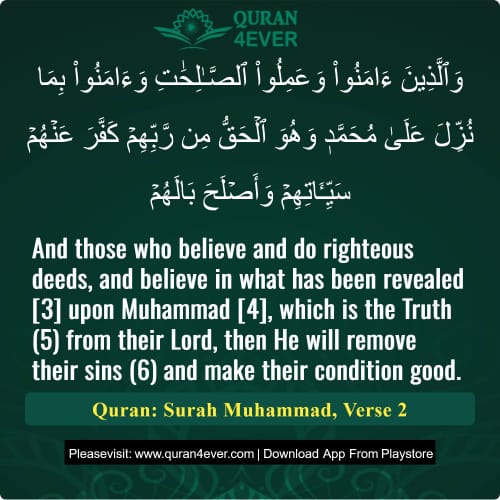
Transliteration:( Wallazeena aamanoo wa 'amilus saalihaati wa aamanoo bimaa nuzzila 'alaa Muhammadinw-wa huwal haqqu mir Rabbihim kaffara 'anhum saiyiaatihim wa aslaha baalahum )
"And those who believe and do righteous deeds, and believe in what has been revealed [3] upon Muhammad [4], which is the Truth [5] from their Lord, then He will remove their sins [6] and make their condition good."
Allah mentions the name “Muhammad” ﷺ in only four places in the Qur’an. This is one of them. Elsewhere, the Prophet is referred to by his noble titles and attributes (e.g., Rasūl, Nabī, Bashīr). Here, the explicit name ensures clarity in faith.
This affirms that a true Muslim must believe specifically in Muhammad ﷺ as the recipient of revelation—not any other prophet. Hence, it is essential to say "Muhammadur Rasūlullāh" as part of the Kalimah for correct belief.
Belief is not limited to the Qur’an alone, but extends to everything revealed to the Prophet ﷺ—whether via the Qur’an or authentic Hadith. Thus, denying a command that the Prophet conveyed, such as the five daily prayers, even though their count is not in the Qur’an explicitly, is disbelief.
Hence, the verse uses the broader term “what was revealed” rather than just mentioning the Qur’an.
Affirming the Qur’an and Sunnah as truth from Allah is the core of true belief. Without belief in Prophethood, all other beliefs like Tawḥīd become meaningless. Rejecting the Messenger ﷺ invalidates one’s claim to faith, no matter how much one believes in Allah.
When a person embraces faith sincerely:
All previous sins committed during disbelief are forgiven.
However, good deeds remain intact—they are not erased.
But it’s important to note: human rights (like debts, thefts, and injustices) are not forgiven by merely embracing Islam. They must still be fulfilled, as Islam upholds justice alongside mercy.
The tafsir of Surah Muhammad verse 2 by Ibn Kathir is unavailable here.
Please refer to Surah Muhammad ayat 1 which provides the complete commentary from verse 1 through 3.
(47:2) As for those who attained to faith and did righteous works and believed in what was revealed to Muhammad[4] � which indeed is the Truth from their Lord[5] � Allah has remitted their evil deeds and has set their condition right.[6]
4. Although after saying alladhina amanu (those who believed) there was no need to say wa amanu bima nuzzila ala Muhammad-in (and accepted that which has been sent down to Muhammad), for belief by itself implies believing in the Prophet Muhammad (peace be upon him) and in the teachings sent down to him, yet making a separate mention of it is particularly meant to assert this. After the appointment of Muhammad (peace be upon him) to Prophethood, a person’s belief in Allah and the Hereafter and the former Messengers and the Books cannot be beneficial until he also believes in him and the teachings brought by him. This explanation was necessary because after the emigration, the Muslims had also to deal with those people, who recognized and accepted all the requirements of the faith but refused to acknowledge and accept the Prophethood of the Prophet Muhammad (peace be upon him).
5. This has two meanings:
(1) That Allah wiped off from their record all those sins which they had happened to commit in the pre-Islamic days of ignorance. Now, they will not at all be held accountable for them.
(2) That Allah removed from them the evils of creed, thought, morals and action in which they were involved. Now their minds were changed, their creed and ideas were changed. Now there was faith in their hearts instead of ignorance, and righteous acts instead of the immoral evil.
6. This also has two meanings:
(1) That Allah changed their previous condition and put them on the right path and improved and bettered their lives for them.
(2) That Allah has taken them out of the condition of weakness and helplessness and oppression in which they were placed till then. Now He has created for them such conditions in which instead of being persecuted they will defend themselves against the oppressors. Instead of living as subjects, they will now live and order their lives as free people, and will have the upper hand instead of being subdued and suppressed.
For a faster and smoother experience,
install our mobile app now.
Related Ayat(Verses)/Topics