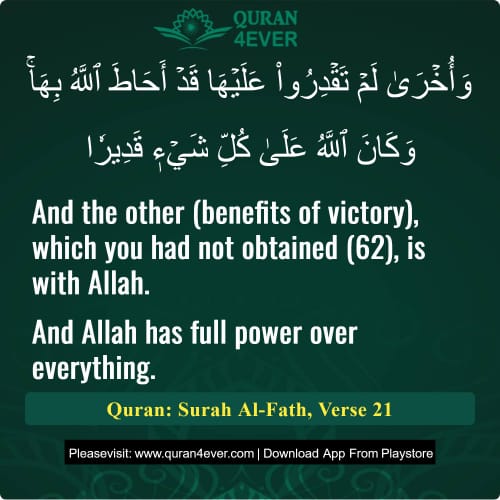
Transliteration:( Wa ukhraa lam taqdiroo 'alaihaa qad ahaatal laahu bihaa; wa kaanal laahu 'alaa kulli shai'in qadeera )
"And the other (benefits of victory), which you had not obtained [62], is with Allah. And Allah has full power over everything."
This refers to victories such as the Conquest of Makkah, and later, the conquests of the Roman and Persian empires during the Caliphate of Hazrat Umar (may Allah be pleased with him). At the time this verse was revealed, such triumphs were beyond imagination, considering the state of the Muslims.
These were not earned solely through human effort, but were gifts from Allah’s grace.
The fulfillment of these victories, particularly in the era of Hazrat Umar, is a clear proof of the truth of his leadership. This affirms that the splendor of Muslim triumphs under his rule was not due to material power, but rather due to divine will and support.
The ending of the verse declares that Allah has full power over all things. Whether it's achieving impossible victories or bestowing success, it all occurs through His command, showing that true control rests only with Him.
The tafsir of Surah Fath verse 21 by Ibn Kathir is unavailable here.
Please refer to Surah Fath ayat 20 which provides the complete commentary from verse 20 through 24.
(48:21) He also promises you other spoils which you have not yet taken, but Allah has encompassed them.[40] Allah has power over everything.
40. Most probably this is a reference to the conquest of Makkah. The same is the opinion of Qatadah and Ibn Jarir. It seems to mean this: Though Makkah has not yet fallen to you, Allah has encircled it, and as a result of this victory at Hudaibiyah, it will also fall to you.
[1515]- i.e., prepared for you or decreed.
For a faster and smoother experience,
install our mobile app now.
Related Ayat(Verses)/Topics