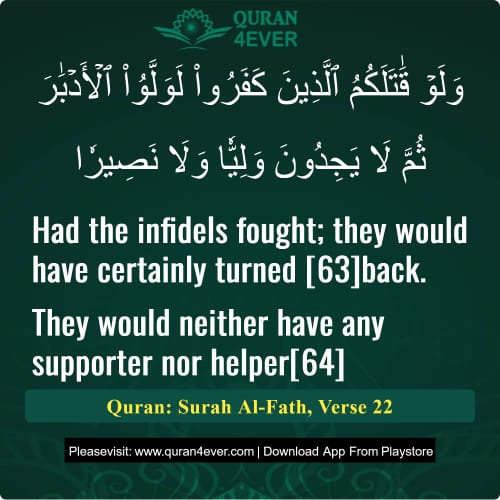
Transliteration:( Wa law qaatalakumul lazeena kafaroo la wallawul adbaara summa laa yajidoona waliyanw-wa laa naseeraa )
"Had the infidels fought; they would have certainly turned [63] back. They would neither have any supporter nor helper [64]."
This refers to the Quraish of Makkah, the infidels of Khaibar, and tribes like Bani Asad and Bani Ghatlaan. They lacked the courage to face the Muslims in battle. Even if they had confronted the Muslims, defeat and humiliation would have been their outcome. The heroic role of Hazrat Ali (may Allah be pleased with him) at Khaibar stands as a manifestation of this divine promise.
The details of this overwhelming victory are recorded in Tafseer Roohul Bayaan.
Some scholars have pointed out that true success in battle is linked to the spiritual sincerity and unwavering faith of the believers. If Muslims today adopt the same self-purification and strive solely for Allah’s pleasure, then the historic scenes of Badr and Hunain can be revived. This verse reminds believers that victory is not about numbers, but about divine support for those sincere in faith.
The tafsir of Surah Fath verse 22 by Ibn Kathir is unavailable here.
Please refer to Surah Fath ayat 20 which provides the complete commentary from verse 20 through 24.
(48:22) Had the unbelievers fought against you at that time, they would have turned their backs (in flight), and would have found none to protect or help them.[41]
41. That is, Allah did not prevent fighting at Hudaibiyah because there was a possibility of your being defeated there, but there were other reasons for it, which are being stated in the following verses. Had that factor not been there and Allah had allowed the war to take place, the disbelievers would surely have been routed and Makkah would have fallen to you at that very time.
For a faster and smoother experience,
install our mobile app now.
Related Ayat(Verses)/Topics