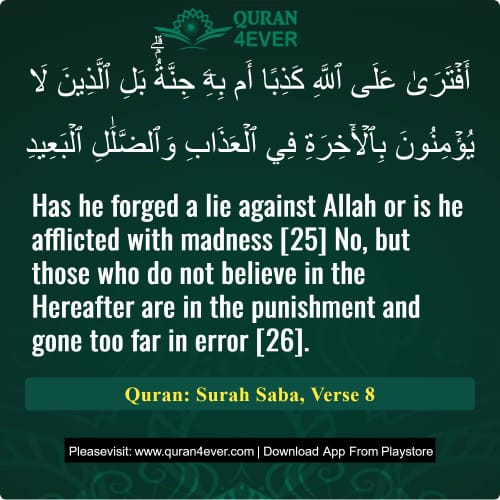
Transliteration:( Aftaraa 'alal laahi kaziban am bihee jinnah; balil lazeena laa yu'minoona bil Aakhirati fil'azaabi wad dalaalil ba'eed )
"Has he forged a lie against Allah or is he afflicted with madness [25]? No, but those who do not believe in the Hereafter are in the punishment and gone too far in error [26]."
This verse reflects the accusations made by disbelievers, claiming that the Prophet ﷺ either fabricated lies about divine revelation or was mentally unstable. Such claims are not only false but completely against the nature of prophethood.
Prophets are divinely protected from conditions like insanity, deafness, or muteness, because these would impair their ability to deliver the message. However, temporary states like unconsciousness may occur, as in: "And Musa fell down unconscious" (S7: V143).
The verse dismisses the baseless claims and clarifies that it is those who deny the Hereafter who are in punishment and have strayed far beyond guidance.
To label the Prophet ﷺ as "just a man," "mad," or "a liar" is to fall into the deepest kind of deviation. Such blasphemy and defamation of the Messenger is among the gravest forms of disbelief, cutting one off from the path of truth and salvation.
The tafsir of Surah Saba verse 8 by Ibn Kathir is unavailable here.
Please refer to Surah Saba ayat 7 which provides the complete commentary from verse 7 through 9.
(34:8) Has he forged a lie against Allah, or is he afflicted with madness?”[10] Nay, but those who do not believe in the Hereafter are doomed to be chastised and are far gone in error.[11]
10. The chiefs of the Quraish knew well that it was extremely difficult for the common people to accuse Muhammad (peace be upon him) of being a liar, for the entire nation knew that he was completely a truthful person, and no one had ever heard a lie from him all his life. Therefore, they presented their charge against him before the people like this: “When this person utters an impossible thing like the life-after-death from his mouth, he is either uttering (God forbid) a falsehood deliberately, or he is mad.” But this accusation of madness also was as absurd as of falsehood, for a stupid person only could admit that such a wise and intelligent man as the prophet (peace be upon him) could be mad. That is why Allah did not feel it was necessary to refute their absurd charge by an argument, and only made mention of their wonder which they expressed at the possibility of the life-after-death.
11. This is the first answer to their charge. It means: “O foolish people, it is you who have lost your reason. For you do not listen to the one who is informing you of the truth and are recklessly galloping on the way that leads to Hell. But the height of your stupidity is that you are calling the one who is anxious for your salvation, a mad peron.”
For a faster and smoother experience,
install our mobile app now.
Related Ayat(Verses)/Topics