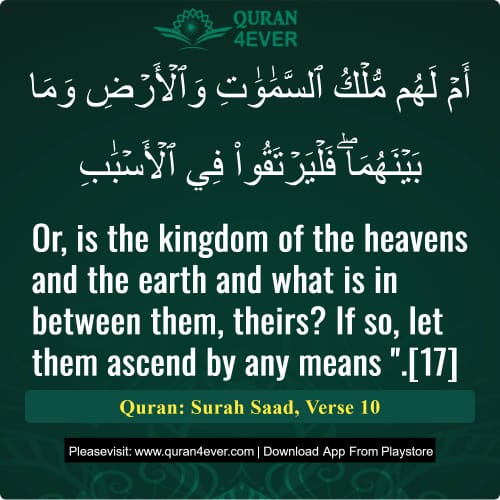
Transliteration:( Am lahum mulkus samaawaati wal ardi wa maa bainahumaa falyartaqoo fil asbaab )
"Or, is the kingdom of the heavens and the earth and what is in between them, theirs? If so, let them ascend by any means. [17]"
This verse continues the divine rebuttal against the arrogance of the disbelievers. It asks: Do they own the universe or control the laws within it? If they believe so, let them rise through any means and assert authority—but they cannot.
The purpose here is to expose their false pride. People sometimes assume that worldly status or wealth gives them power, but even in worldly matters, riches don’t follow logic—the ignorant can be wealthy while the wise remain poor.
Therefore, if worldly success is not always based on effort or merit, how can something as lofty as Prophethood be claimed or acquired through human logic or means? The verse powerfully reminds us that only Allah governs the heavens and the earth, and only He determines who receives His special mercy.
The tafsir of Surah Sad verse 10 by Ibn Kathir is unavailable here.
Please refer to Surah Sad ayat 4 which provides the complete commentary from verse 4 through 11.
(38:10) Or do they possess the dominion of the heavens and the earth and of all that is in between them? If so, let them ascend the heights of the realm of causation and see![11]
11. This is an answer to this saying of the disbelievers: Was he the only (fit) person among us to whom Allah’s admonition should have been sent down? Allah says: It is for Us to decide whom We should choose and appoint as a Prophet and whom We should not. These people do not possess any power and authority to exercise choice in this regard. If they wish to attain such an authority, they should try to reach the divine Throne in order to obtain control over the office of sovereignty of the Universe, so that revelation should come down on him whom they regard as deserving their mercy and not on him whom We regard as fit for it. This theme has occurred at several places in the Quran, because the unbelieving Quraish again and again said: How did Muhammad (peace be upon him) become a Prophet? Did Allah find no better man among the principal leaders of the Quraish worthy of this office? See (Surah Bani-Israil, Ayat 100); (Surah Az-Zukhruf, Ayat 31-32).
[1321]- To oversee the affairs of their dominion.
For a faster and smoother experience,
install our mobile app now.
Related Ayat(Verses)/Topics