Transliteration:( Yaaa aiyuhan Nabiyyu harridil mu'mineena 'alal qitaal; iny-yakum minkum 'ishroona saabiroona yaghliboo mi'atayn; wa iny-yakum minkum mi'atuny yaghlibooo alfam minal lazeena kafaroo bi anahum qawmul laa yafqahoon )
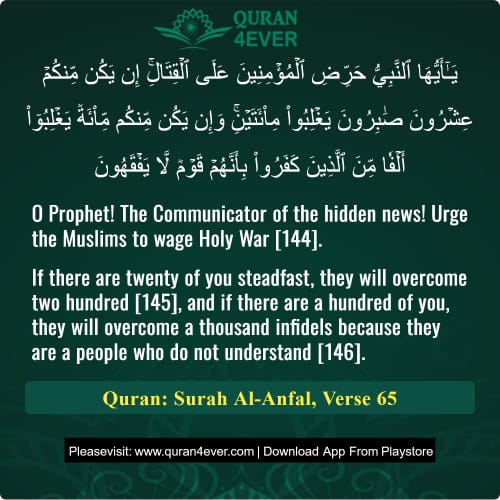
"O Prophet! The Communicator of the hidden news! Urge the Muslims to wage Holy War [144]. If there are twenty of you steadfast, they will overcome two hundred [145], and if there are a hundred of you, they will overcome a thousand infidels because they are a people who do not understand [146]."
This verse reveals two key rulings:
Jihād (Holy War) is among the greatest acts of worship, and the Prophet ﷺ was commanded to instill desire for it in the hearts of believers. Anyone who discourages participation in it—such as Mirza Ghulam Qadiani—is acting in opposition to Divine command.
All permissible means of encouraging Jihād are allowed. This includes salaries for soldiers, supporting their families, and honoring their bravery.
This verse brings both glad tidings and a command. The glad tidings are that, by Allah’s grace, Muslims would overpower disbelievers ten times their number—a promise that was fulfilled. The command is that Muslim soldiers must not retreat, even if outnumbered ten to one. However, this command was later abrogated by the verse, “Now Allah has lightened your burden”, indicating a reduction in this obligation, not the glad tidings.
Disbelievers are described as a people who do not understand, because their fighting is for pride or worldly gain, not for Allah’s pleasure. Their struggle is likened to animals fighting instinctively, lacking any higher purpose. In contrast, Muslims fight purely for Allah and His Messenger ﷺ, which gives them moral strength and spiritual clarity. Fighting for nationalism or territorial gain is portrayed as ignorance.
The tafsir of Surah Al-Anfal verse 65 by Ibn Kathir is unavailable here.
Please refer to Surah Anfal ayat 64 which provides the complete commentary from verse 64 through 66.
(8:65) O Prophet! Rouse the believers to fighting. If they be twenty of you who persevere they shall vanquish two hundred; and if there be of you a hundred, they shall vanquish a thousand of those who disbelieve, for they are a people who lack understanding.[47]
47. What is nowadays called morale has been described as ‘understanding’ in the Qur’an. The Qur’anic expression is more scientific than the currently used word ‘morale’. For the word in this context refers to the one who is fully cognizant of his objective, who is quiet clear in his mind that the cause for which he has staked his life is much more valuable than his own life, and hence if that cause is left unrealized, his life will lose all its worth and meaning. Such a conscious, comitted person actually becomes many times more powerful than he who fights without any consciousness of his cause, even though the two might be comparable in physical strength. Above all, he who has a clear understanding of reality of his own being, of God, of his relationship with God, of the reality of life and death, and of life after death, who is also well aware of the difference between truth and falsehood, and of the consequences of the victory of falsehood over truth, his strength surpasses by far the strength of others for whom, even though they ‘understand’, their consciousness is related to nationalism or patriotism or class conflict. It is for this reason that the Qur’an declares that a believer with understanding is ten times stronger than an unbeliever. For the believer understands the truth and a non-believer does not. It may be remembered, however, that the verse also mentions another important factor in addition to ‘understanding’ which makes a believer much stronger than an unbeliever, and that is ‘patience’.
For a faster and smoother experience,
install our mobile app now.
Related Ayat(Verses)/Topics