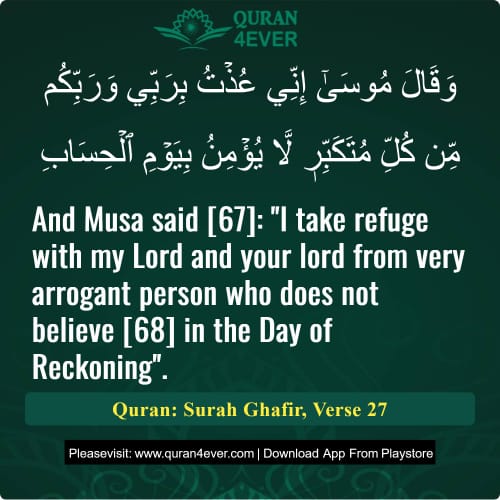
Transliteration:( Wa qaala Moosaaaa innee 'uztu bi Rabbee wa Rabbikum min kulli mutakabbiril laayu'minu bi Yawmil Hisaab (section 3) )
"And Musa said [67]: 'I take refuge with my Lord and your Lord from every arrogant person who does not believe [68] in the Day of Reckoning.'"
Prophet Musa (peace be upon him) made this statement in response to Pharaoh’s threats. But instead of reacting with fear or pride, he calmly turned to Allah, declaring his trust and reliance on the One true Lord. This was not just to declare his faith, but also to reassure and pacify the people, showing that true power lies with Allah, not tyrants.
Several important insights emerge from this verse:
Responding with humility – Musa did not boast or threaten in return. Even when facing oppression, a believer should not claim personal greatness but rather respond with humility and trust in Allah.
Reliance on Allah – The verse teaches us to seek protection in Allah during times of hardship. Even in the face of a powerful enemy like Pharaoh, Musa chose du’a and submission over confrontation.
Call upon Allah’s lordship over all – Musa says “my Lord and your Lord,” reminding that even Pharaoh is under Allah’s authority, whether he accepts it or not. Tawheed (Oneness of Allah) is reaffirmed here with clarity.
Power of this supplication – Since this du’a was spoken by a Prophet, it holds special value and effectiveness in seeking protection from arrogant enemies, especially those who reject the Hereafter and act as if they are accountable to no one.
This verse is a beautiful example of how faith, humility, and trust in Allah form the best response to oppression and arrogance.
The tafsir of Surah Muminun verse 27 by Ibn Kathir is unavailable here.
Please refer to Surah Muminun ayat 23 which provides the complete commentary from verse 23 through 27.
(40:27) Moses said: “I have taken refuge with my Lord and your Lord from everyone who waxes arrogant and does not believe in the Day of Reckoning.”[44]
44. Here, there are two equal probabilities and there is no ground for preferring one to the other. The first probability is that the Prophet Moses (peace be upon him) might himself be present in the court at the time and Pharaoh might have expressed his intention to kill him in his presence, and the Prophet might have given this direct answer there and then, addressing him and his courtiers. The other probability is that Pharaoh might have expressed this intention in the absence of Moses in a meeting with the responsible people of his government and a report of this conversation might have been conveyed to the Prophet by some of the believers, whereupon he might have said these words in some gathering of his followers. Whatever be the case, it is apparent from the words that the threat of Pharaoh could not cause any state of fear in Moses’ heart and with trust in Allah he flung his threat back at Pharaoh. The context in which this event has been related in the Quran by itself shows that the same also was the reply from the Prophet Muhammad (peace be upon him) to those wicked people who, being fearless of the Day of Reckoning, were devising plots to kill him.
For a faster and smoother experience,
install our mobile app now.
Related Ayat(Verses)/Topics