Transliteration:( Wa laqad jaaa'ahum Rasoolum minhum fakazzaboohu fa akhazahumul 'azaabu wa hum zaalimoon )
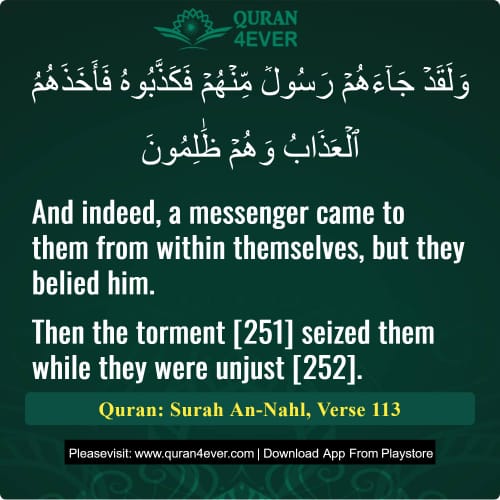
113. And indeed, a messenger came to them from within themselves, but they belied him. Then the torment [251] seized them while they were unjust [252].
[251] This verse refers to the Holy Prophet ﷺ who came as a messenger from among the very people of Makkah, their own community and tribe. Despite this clear sign, they rejected and disbelieved him. The “torment” mentioned here signifies a severe famine that befell the people of Makkah. This punishment was accompanied by the fear and dominance of the believers, which subdued the disbelievers.
[252] Instead of accepting the Prophet ﷺ as the true Messenger of Allah, the infidels of Makkah unjustly accused him of being a poet or magician, labels meant to discredit and mock his message. Their refusal to recognize the truth was a manifestation of their injustice and arrogance.
The tafsir of Surah An-Nahl verse 113 by Ibn Kathir is unavailable here.
Please refer to Surah Nahl ayat 112 which provides the complete commentary from verse 112 through 113.
(16:113) Most certainly a Messenger came to them from among them; but they rejected him, calling him a liar. Therefore chastisement seized them while they engaged in wrong-doing.[112]
112. That habitation has not been specified here nor have the commentators definitely pointed out which that habitation was. However, there is a saying of Ibn Abbas (which seems to be correct) that the place referred to is Makkah itself. In that case, hunger and fear will mean the famine which prevailed over the people of Makkah for several years during the Prophethood of Muhammad (peace be upon him).
For a faster and smoother experience,
install our mobile app now.
Related Ayat(Verses)/Topics