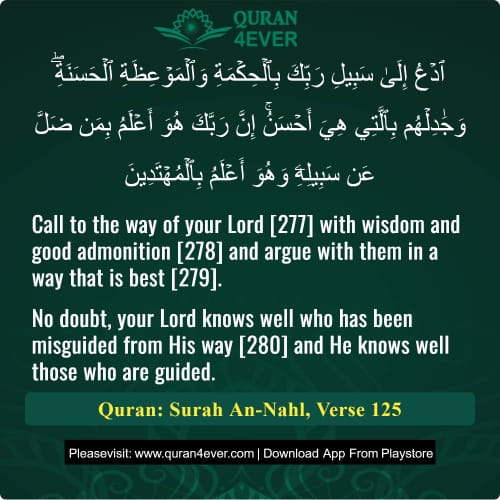
Transliteration:( Ud'u ilaa sabeeli Rabbika bilhikmati walmaw 'izatil hasanati wa jaadilhum billatee hiya ahsan; inna Rabbaka huwa a'almu biman dalla 'an sabeelihee wa Huwa a'lamu bilmuhtadeen )
125. Call to the way of your Lord [277] with wisdom and good admonition [278] and argue with them in a way that is best [279]. No doubt, your Lord knows well who has been misguided from His way [280] and He knows well those who are guided.
[277] This verse commands the Prophet Muhammad (peace be upon him), and by extension all believers, to invite all creation towards Islam, the true path. The Prophethood and mission of the Holy Prophet is universal and will continue until the Day of Judgment. Initially, the Prophet directly propagated Islam to his noble Companions, and after him, scholars (Ulama) carry forward this responsibility.
Islam alone is recognized by Allah Almighty as the true religion, while all other faiths are described as paths leading away from Him. As Allah states elsewhere:
“Verily, only Islam is the Religion before Allah” (3:19).
[278] The call to Islam must be made with wisdom, which includes offering positive and clear proofs, inspiring inclination towards faith, invoking fear of consequences, and recounting incidents from previous peoples as lessons.
[279] Arguments and debates should be conducted in the best and most respectful way, matching the capacity and mindset of the audience. The aim is to guide, not to create discord or mischief.
From this, two important principles arise:
Debating religious issues with those who lack faith can be beneficial.
Different approaches work for different groups: some respond better to proofs, others to moral stories or fear of consequences. Hence, propagation is diversified to fit the varied nature of people.
[280] Ultimately, despite all efforts in preaching and debating, the nature or destiny of people does not change by human effort alone. Guidance is from Allah alone, and He knows perfectly who has been truly guided or misguided.
This serves to remind the believers that while they must fulfill their duty in inviting others, they should also recognize that success in guidance is determined by Allah.
125. Invite to the way of your Lord with wisdom and fair preaching, and argue with them with that which is best. Truly, your Lord best knows who has strayed from His path, and He best knows those who are guided.
Allah commands His Messenger Muhammad to invite the people to Allah with Hikmah (wisdom). Ibn Jarir said: “That is what was revealed to him from the Book and the Sunnah.”
(and fair preaching) meaning, with exhortation and stories of the events that happened to people that are mentioned in the Qur’an, which he is to tell them about in order to warn them of the punishment of Allah.
(and argue with them with that which is best.) meaning, if any of them want to debate and argue, then let that be in the best manner, with kindness, gentleness and good speech, as Allah says elsewhere:
(And do not argue with the People of the Book, unless it be with that which is best, except for those who purposefully do wrong.) ﴿29:46﴾ Allah commanded him to speak gently, as He commanded Musa and Harun to do when he sent them to Pharaoh, as He said:
(And speak to him mildly, perhaps he may accept admonition or fear (Allah))(20: 44).
(Truly, your Lord best knows who has strayed from His path,) meaning, Allah already knows who is doomed (destined for Hell) and who is blessed (destined for Paradise). This has already been written with Him and the matter is finished, so call them to Allah, but do not exhaust yourself with regret over those who go astray, for it is not your task to guide them. You are just a warner, and all you have to do is convey the Message, and it is He Who will bring them to account.
(You cannot guide whom you love) ﴿28:56﴾
(It is not up to you to guide them, but Allah guides whom He wills.) ﴿2:72﴾
(16:125) (O Prophet), call to the way of your Lord with wisdom and goodly exhortation,[122] and reason with them in the best manner possible.[123] Surely your Lord knows best who has strayed away from His path, and He also knows well those who are guided to the Right Way.
122. This instruction is very important for those who are engaged in the propagation of Islam. They should always keep in view two things, wisdom and excellent admonition. Wisdom implies that one should use discretion in the work of propagation and should not do this blindly like foolish people. Wisdom demands that one should keep in view the intelligence, capability and circumstances of the addressees and convey the message in accordance with the requirements of the occasion. Moreover, one should refrain from applying one and the same method to each and every person or group but should first diagnose the real disease of the addressee and then cure it by appealing to his mind and intellect.
Excellent admonition implies two things:
(1) One should not be content with convincing the addressee with arguments alone but should also appeal to his feelings. Likewise one should not confine himself merely to arguments in condemning evils and deviations but should try to convince the other of their repugnance that lies embedded in the human nature. One should also warn of the worst consequences of those evils. Besides, one should not only try to convince the addressee rationally of the soundness and excellence of guidance and righteous deeds but should also create in him interest and love for them.
(2) Admonition should be administered in such a manner as to show sincere concern for and the welfare of the addressee. Nothing should be said or done to create the impression that the admonisher is looking down upon him and taking pleasure in his own feeling of superiority. On the contrary, he should feel that the admonisher is filled with the strong desire for his reform and welfare.
123. “In a way that is better” implies that one should have a sweet tongue, show noble character and give reasonable and appealing arguments, and refrain from indulging in polemics, argumentation and controversies. The one who discusses things with people in the best manner, does not resort to accusations, crooked arguments, taunts, nor makes fun of the opponent in order to defeat him and to win applause for his own superiority in argument. For these things will produce obduracy and obstinacy. In contrast to this, he will try to convince the other in a simple and humble way, and when he feels that the other person has come down to crooked arguments, he will leave him alone lest the other should go further and further astray in his deviation.
For a faster and smoother experience,
install our mobile app now.
Related Ayat(Verses)/Topics