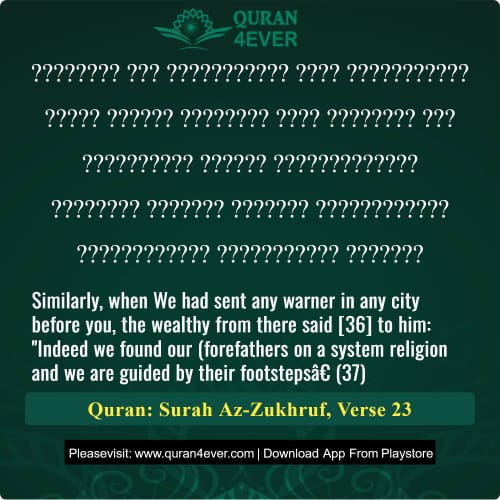
Transliteration:( Wa kazaalika maaa arsalnaa min qablika fee qaryatim min nazeerin illaa qaala mutrafoohaaa innaa wajadnaaa aabaaa'anaa 'alaaa ummatinw wa innaa 'alaaa aasaarihim muqtadoon )
"Similarly, when We had sent any warner in any city before you, the wealthy from there said [36] to him: 'Indeed we found our forefathers on a system (religion), and we are guided by their footsteps' [37]."
This verse highlights that Prophets were mostly rejected by the wealthy elites, while the poor were more receptive. Even today, the preservation of religion largely continues through the poor—Ulama, Huffaz, and pious individuals—who usually emerge from humble backgrounds.
The disbelievers refused change, insisting: “We will follow our ancestors no matter what.” Such blind stubbornness, especially when the truth is made clear, is labeled here as an act of disbelief. Refusing divine guidance in favor of inherited error is a grave spiritual crime.
The tafsir of Surah Zukhruf verse 23 by Ibn Kathir is unavailable here.
Please refer to Surah Zukhruf ayat 21 which provides the complete commentary from verse 21 through 25.
(43:23) And thus it is: whenever We sent any warner to a city its affluent ones said: “We found our forefathers on a way and we continue to follow in their footsteps.”[23]
23. Here, the point worth consideration is why only the well to do people of every community have resisted the Prophets and upheld the imitation of their forefathers in every age. Why have they alone been in the forefront to oppose the truth and to endeavor to maintain the established falsehood and to beguile and incite the common people against them? Its basic causes were two:
(1) The well to do and affluent people are so absorbed in making and enjoying the world of their own that they are not inclined to bother themselves about the useless debate (as they assume it to be) between the truth and falsehood. Their love of ease and mental lethargy renders them so heedless of religion and conservative that they want the established order, no matter whether it is based on truth or falsehood, to retrain in force so that they do not have to take the trouble of thinking about the new order at all for themselves.
(2) Their interests become so dependent on the established order that when they get the first glimpse of the order presented by the Prophets, they start feeling that if it came, it would not only put an end to their leadership but also would deprive them of the freedom to consume the lawful and commit the unlawful. For further details, see (Surah Al-Anaam, Ayat 103); (Surah Al-Aaraf, Ayat 66-70). (Surah Al-Aaraf, Ayat 75), (Surah Al-Aaraf, Ayat 88), (Surah Al-Aaraf, Ayat 109), (Surah Al-Aaraf, Ayat 127); (Surah Houd, Ayat 27-28); (Surah Bani-Israil, Ayat 16); (Surah Al-Muminun, Ayat 24-33), (Surah Al-Muminun, Ayat 46); (Surah Saba, Ayat 34) and the corresponding E.Ns.
For a faster and smoother experience,
install our mobile app now.
Related Ayat(Verses)/Topics