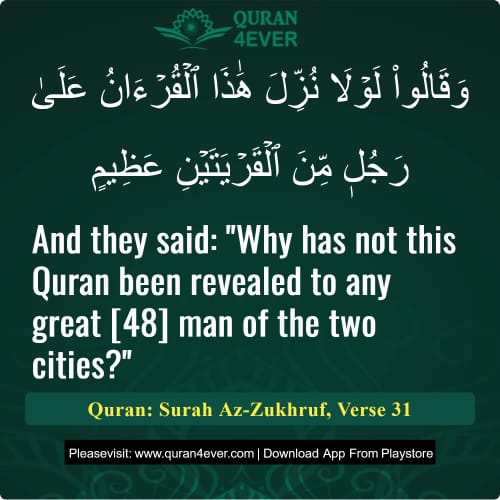
Transliteration:( Wa qaaloo law laa nuzzila haazal Quraanu 'alaa rajulin minal qaryataini 'azeem )
"And they said: 'Why has not this Qur’an been revealed to any great [48] man of the two cities?'"
This verse reveals the arrogant mindset of the disbelievers, who judged worthiness by worldly power and status. They questioned why the Qur’an was revealed to Prophet Muhammad ﷺ, instead of someone wealthy or influential from Makkah or Taif—like Walid ibn Mugheerah or Urwah ibn Masood Thaqafi.
They overlooked the loftiness of Prophethood, which is based on divine wisdom, purity, and sincerity, not material wealth. The most honored in Allah’s sight are the Prophets, not the rich or the tribal leaders. Their rejection shows how disbelief blinds people into valuing status over spiritual truth.
The tafsir of Surah Zukhruf verse 31 by Ibn Kathir is unavailable here.
Please refer to Surah Zukhruf ayat 26 which provides the complete commentary from verse 26 through 35.
(43:31) They say: “Why was this Qur’an not sent down upon some great man from the two (main) cities?”[30]
30. The two towns: Makkah and Taif. What the disbelievers meant was: Had Allah really willed to send a messenger and intended to send down a book to him, He would have selected a great man from our these central cities for the purpose. For Allah could not have selected for this great mission a person who was born an orphan, who did not inherit much property, who passed his youth by tending goats, who even at present earned his living through business with his wife’s money, and who was neither the chief of a tribe nor the head of a family. Were not there well known chiefs like Walid bin Mughirah and Utbah bin Rabiah in Makkah, and nobles like Urwah bin Masud, Habib bin Amr, Kinanah bin Abdi Amr and Ibn Abd Yalil in Taif? This was their reasoning in the first instance, they were also not inclined to believe that a man could be a Messenger. But when the Quran refuted this misconception by argument and reason and they were told that in the past only men had come as Messengers and a man only could be a Messenger for the guidance of the people, and not another kind of being and the Messenger who came did not descend suddenly from heavens but were born in the same ordinary dwellings, walked about in the streets, had children and families and stood in need of food and drink see (Surah An-Nahl, Ayat 43); (Surah Bani Israil, Ayat 94-95); (Surah Yousuf, Ayat 109); (Surah Al-Furqan, Ayat 7), (Surah Al-Furqan, Ayat 20); (Surah Al-Anbiya, Ayat 7-8); (Surah Ar-Raad, Ayat 38), they took this stand, saying: Well, even if a human being, he should be a big man, who should be wealthy, influential and awe-inspiring and having a large following. How could Muhammad bin Abdullah (peace be upon him) be fit for this appointment?
[1439]- Referring to Makkah and aṭ-Ṭā’if.
For a faster and smoother experience,
install our mobile app now.
Related Ayat(Verses)/Topics