Transliteration:( Wa feee amwaalihim haqqul lissaaa'ili walmahroom )
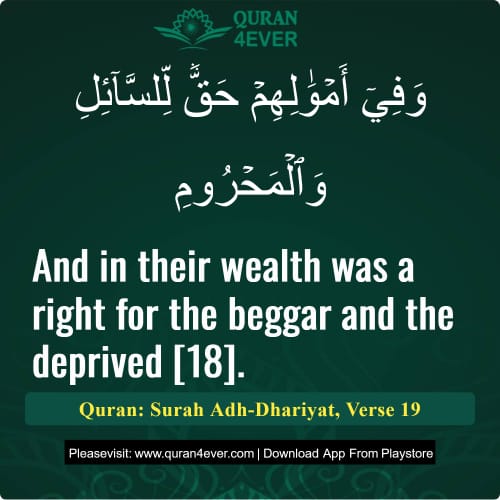
"And in their wealth was a right for the beggar and the deprived[18]."
This verse describes several qualities of the believers in relation to their wealth:
A portion of their wealth is dedicated to the poor and needy, which includes their food, clothing, money, etc.
They give to all types of beggars, whether they know them or not, ensuring that the needy are supported.
Their giving is not dependent on what the beggar asks. They give to the destitute and also search for those who are too ashamed to ask, often those who are deprived of receiving charity due to their shamefulness.
They do not treat the poor as recipients of pity, but consider it their right to receive charity from their earnings. They are grateful to the poor for accepting their charity.
It should be remembered that this refers to voluntary charity. Zakat, which became obligatory after the Hijrah, is not discussed here, and this verse focuses on the voluntary giving to those in need.
The tafsir of Surah Ad-Dhariyat verse 19 by Ibn Kathir is unavailable here.
Please refer to Surah Dhariyat ayat 15 which provides the complete commentary from verse 15 through 23.
(51:19) and in their wealth there was a rightful share for him who would ask and for the destitute.[17]
17. In other words, on the one hand, they recognized the right of their Lord and duly discharged it; on the other hand, they did not think that whatever Allah had given them, whether little or much, was wholly their own and their children’s right, but they had the sense that in their possessions there was the right and share of every such person who was indigent and needy. They did not render help to the people as a charity so as to earn their gratitude for the favor done, but they regarded it as the people’s right and discharged it as their own duty. Then their this service to mankind was not only confined to those who came to them for seeking help as beggars but anyone about whom they came to know that he had been left destitute, they would become anxious to render him necessary help of their own accord. There was no orphan who might have been left helpless, no widow who might have had no breadwinner, no disabled person who might be unable to earn a living, no one who might have lost his job, or whose taming might not be sufficing his needs, nobody who might have been hit by a calamity and might be unable to compensate for the loss by himself. In short, there was no needy one whose condition they might have known and yet might have withheld their help when they could have rendered him necessary help and support.
The following are the three qualities on the basis of which Allah regards them as the righteous doers of good, and says that these very qualities have made them worthy of Paradise: (1) That they believed in the Hereafter and refrained from every act and conduct which Allah and His Messenger had stated to be disastrous for the life-after-death. (2) That they executed their utmost to do full justice to the service of Allah and still sought Allah’s forgiveness instead of exulting at their acts of piety. (3) That they served Allah’s servants not as a favor to them but as their own duty and their right due from them.
Here, one should also know and understand another thing; The right of the needy ones that has been mentioned here in the wealth of the believers does not imply the zakat, which has been imposed as religious duty on them. But this is the right that a well-to-do believer himself feels there is in his possessions of the needy even after he has paid off the zakat, and he discharges it willingly even if it has not been made obligatory by the Shariah. lbn Abbas, Mujahid, Zaid bin Aslam and other scholars have understood this very meaning of this verse. In fact, the real spirit of this divine command is that a pious and virtuous person is never involved in the misunderstanding that he has become relieved of his duty of discharging the right of Allah and His servants that there was in his possessions after he has paid the zakat, and now he is not bound to help every needy and destitute person whom he comes across. Contrary to this, every servant of Allah, who is really pious and righteous, remains ever ready to do whatever good he can do willingly, does not let slip any opportunity when he could do some good to the people in the world. He is not of the way of thinking that he has done whatever good he had been enjoined to do and now no more good is required to be done by him. The one who has recognized the true value of goodness, does not perform it as a burden but tries to earn more and more of it, greedily as a bargain to his own advantage, in his own interest.
For a faster and smoother experience,
install our mobile app now.
Related Ayat(Verses)/Topics