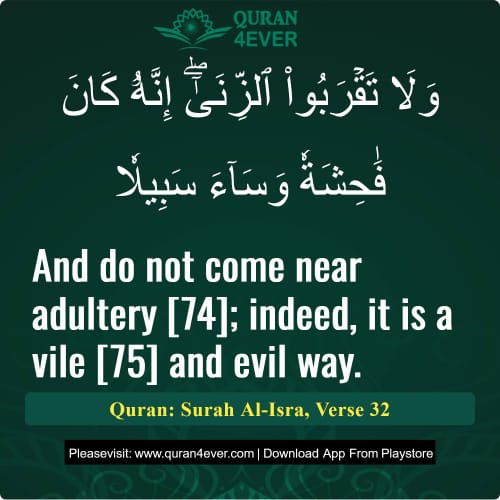
Transliteration:( Wa laa taqrabuz zinaaa innahoo kaana faahishatanw wa saaa'a sabeelaa )
"And do not come near adultery [74]; indeed, it is a vile [75] and evil way."
This means safeguard yourself not just from adultery itself, but also from anything that leads to it.
Thus, actions such as casting an evil eye, being alone with a non-mahram woman, and immodest exposure by women are all forbidden.
To prevent a disease, one must block its earliest triggers—just like preventing fever requires stopping inflammation, and stopping a plague starts by eliminating rats.
Therefore, the obligation of Purdah, the prohibition of music, and the command to lower the gaze are all part of Islam’s preventive framework against adultery.
From this we learn that adultery is a worse crime than murder, because:
The punishment for murder is death
The punishment for adultery (by a married person) is Rajm (stoning to death)
This is because adultery is not only a crime, but also an act of shamelessness, and a violation of the sacredness of human procreation.
32. And come not near to unlawful sex. Verily, it is Fahishah (immoral sin) and an evil way.
Allah says, forbidding His servants to commit Zina or to approach it or to do anything that may lead to it:
(And come not near to unlawful sex. Verily, it is a Fahishah (immoral sin)) meaning a major sin,
(and an evil way.) meaning, a terrible way to behave. Imam Ahmad recorded Abu Umamah saying that a young man came to the Prophet and said, “O Messenger of Allah! Give me permission to commit Zina (unlawful sex).” The people surrounded him and rebuked him, saying, “Stop! Stop!” But the Prophet said,
(Come close) The young man came to him, and he said,
(Sit down) so he sat down. The Prophet said,
(Would you like it (unlawful sex) for your mother) He said, “No, by Allah, may I be ransomed for you.” The Prophet said,
(Neither do the people like it for their mothers.) The Prophet said,
(Would you like it for your daughter) He said, “No, by Allah, may I be ransomed for you.” The Prophet said,
(Neither do the people like it for their daughters. ) The Prophet said,
(Would you like it for your sister) He said, “No, by Allah, may I be ransomed for you.” The Prophet said,
(Neither do the people like it for their sisters.) The Prophet said,
(Would you like it for your paternal aunt) He said, “No, by Allah, O Allah’s Messenger! may I be ransomed for you.” The Prophet said,
(Neither do the people like it for their paternal aunts.) The Prophet said,
(Would you like it for your maternal aunt) He said, “No, by Allah, O Allah’s Messenger! may I be ransomed for you.” The Prophet said,
(Neither do the people like it for their maternal aunts.) Then the Prophet put his hand on him and said,
(O Allah, forgive his sin, purify his heart and guard his chastity.) After that the young man never paid attention to anything of that nature.
(17:32) (viii) Do not even approach fornication for it is an outrageous act, and an evil way.[32]
32. “And do not come near to adultery”. This commandment is meant both for individuals and society as a whole. It warns each individual not only to guard against adultery or fornication itself but against all those things that lead to or stimulate it. As regards to society as a whole the commandment enjoins it to make such arrangements as prevent adultery and eradicate the means and stimulants that lead to adultery. Therefore, the society should employ all those legal and educative means that help develop such an environment as prevents and eradicates indecency.
Finally, this article formed the basis of laws and regulations of the Islamic system of life. In order to fulfill its implications adultery and false accusation of adultery were made criminal offenses. Regulations about hijab were promulgated. The publication of indecent materials was banned and drinking of intoxicants was made unlawful. Restrictions on music, dancing and pictures which are conducive to adultery were imposed. Such laws were enacted and marriage was made easy to and cut at the root of adultery.
[741]- i.e., avoid all situations that might possibly lead to it.
For a faster and smoother experience,
install our mobile app now.
Related Ayat(Verses)/Topics