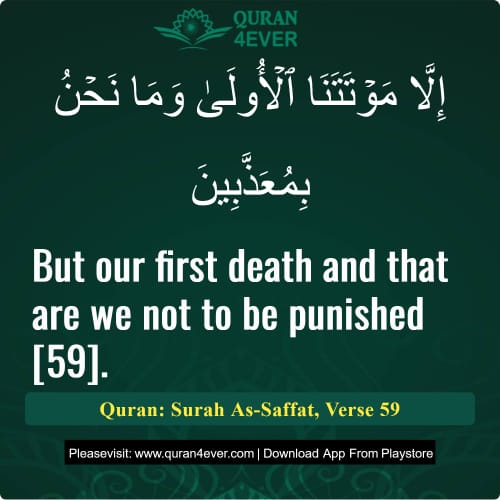
Transliteration:( Illa mawtatanal oola wa maa nahnu bimu'azzabeen )
"But our first death and that are we not to be punished [59]."
The inmates of Paradise will ask the angels this question while witnessing the slaughtering of death, often symbolized as a sheep being sacrificed.
This marks the declaration that from that moment onward, eternal life begins, and no one will experience death again.
Their question is not out of doubt or interrogation, but a joyous expression reflecting their happiness at the end of death and suffering.
The tafsir of Surah As-Saffat verse 59 by Ibn Kathir is unavailable here.
Please refer to Surah Saffat ayat 50 which provides the complete commentary from verse 50 through 61.
(37:59) except for our first death? And shall we suffer no chastisement?'”[33]
33. The style clearly shows that while speaking to his friend in Hell, the dweller of Paradise suddenly starts talking to himself. He speaks these three sentences in a way as if he found himself in a state much better than that he ever expected and imagined for himself, and now being beside himself with wonder and joy he is engaged in a sort of soliloquy. In such a state the speaker does not speak to an addressee, nor the questions he asks are meant to find out something from somebody, but in this state the man’s own feelings find expression through his tongue. The dweller of Paradise, while speaking to the dweller of Hell, suddenly starts feeling how he has been favored by good fortune: now there is neither death nor any torment: all troubles and distresses have come to an end and he has been blessed with immortality. Under this very feeling he exclaims: Well are we not to die any other than our first death? Are we not to be punished?
For a faster and smoother experience,
install our mobile app now.
Related Ayat(Verses)/Topics