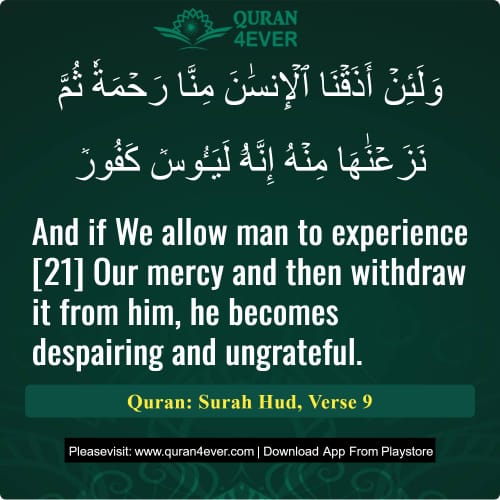
Transliteration:( Wa la'in azaqnal insaana minnaa rahmatan summa naza'naahaa minhu, innahoo laya'oosun kafoor )
"And if We allow man to experience [21] Our mercy and then withdraw it from him, he becomes despairing and ungrateful."
By "man," this verse refers either to an infidel or a negligent person. From this, we learn that to despair of the mercy of Allah Almighty is the characteristic behavior of infidels. The coming of mercy and blessings serves to encourage gratitude, while their withdrawal is meant to foster patience. Therefore, both the coming and going of mercy are, in fact, part of Allah’s mercy itself, as they are designed to shape the believer’s response and strengthen their faith.
9. And if We give man a taste of mercy from Us, and then withdraw it from him, verily, he is despairing, ungrateful. 10. But if We let him taste good (favor) after evil (poverty and harm) has touched him, he is sure to say: “Ills have departed from me.” Surely, he is exultant and boastful (ungrateful to Allah). 11. Except those who show patience and do righteous good deeds: those, theirs will be forgiveness and a great reward (Paradise).
Allah, the Exalted, informs about mankind and the blameworthy characteristics that he possesses, except for those believing servants upon whom Allah has bestowed His mercy. Allah explains that when any hardship befalls man, after he has experienced blessings, he is disheartened and he despairs of any good in the future. He denies and rejects (the bounties of) his previous condition. Thus, he behaves as if he has never seen any good and he loses all hope for relief (from his situation). Likewise, if any blessing befalls him after displeasure,
(he is sure to say, “Ills have departed from me.”) This means that he will claim that no harm or calamity will afflict him after this (blessing).
(Surely, he is exultant and boastful (ungrateful to Allah).) This means that he is pleased with what he has in his hand and ungrateful (to Allah). At the same time he is boastful towards others. Allah, the Exalted, then says,
(Except those who show patience) meaning, those who show patience during times of hardship and adversity. In reference to Allah’s statement,
(and do righteous good deeds) This means that they perform the good deeds in times of ease and good health. Concerning the statement,
(those, theirs will be forgiveness) meaning, that they will be forgiven due to the calamities that afflicted them. Concerning Allah’s statement,
(and a great reward.) This great reward is due to them because of what they sent forth (of good deeds) in their times of ease. This is similar to what is mentioned in the Hadith,
(By He in Whose Hand is my soul! No worry, calamity, distress, illness, or grief strikes a believer, even the prick of a thorn, except that Allah will expiate his sins for him because of it.) In the Sahih it is recorded that the Prophet said,
(By He in Whose Hand is my soul! Allah does not decree any matter for the believer except that it is good for him. If any blessing befalls him, he is thankful (to Allah) and that is good for him. If any harm comes to him, he is patient and that is also good for him. This is (a bounty) exclusively for the believer.) For this reason, Allah, the Exalted, says,
(By Al-`Asr (the time). Verily, man is in loss. Except those who believe and do righteous good deeds. And recommend one another to the truth and recommend one another to patience.) ﴿103:1-3﴾ Allah also says,
(Verily, man was created very impatient.) ﴿70:19﴾
(11:9) If We ever favour man with Our Mercy, and then take it away from him, he becomes utterly desperate, totally ungrateful.
There is no commentary by Abul Maududi available for this verse.
For a faster and smoother experience,
install our mobile app now.
Related Ayat(Verses)/Topics