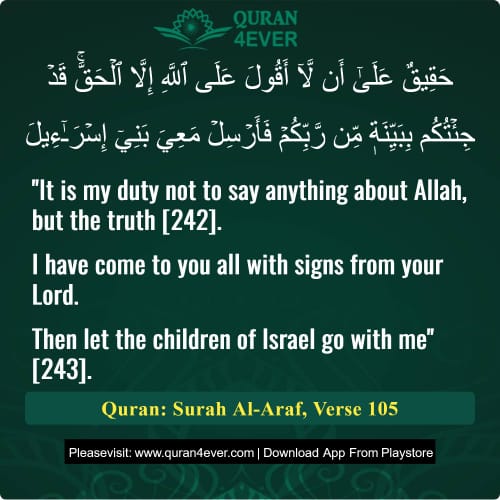
Transliteration:( Haqeequn 'alaaa al laaa aqoola 'alal laahi illal haqq; qad ji'tukum bibaiyinatim mir Rabbikum fa arsil ma'iya Baneee Israaa'eel )
"It is my duty not to say anything about Allah, but the truth (242). I have come to you all with signs from your Lord. Then let the children of Israel go with me" (243).
In this verse, Musa (peace be upon him) affirms that a Prophet can never speak falsely about Allah. His duty is to convey only what is true and divinely revealed. There is an unbreakable bond between truth and prophethood—just as light cannot mix with darkness, a Prophet cannot mix falsehood with truth. This emphasizes that every word uttered by a Prophet, especially regarding Allah, is a pure reflection of divine truth.
Musa’s message was not just to call Pharaoh to faith, but also to demand the release of Bani Israel. He was sent as a liberator, asking Pharaoh to let the Israelites go with him, freeing them from centuries of slavery and oppression. This was a direct challenge to Pharaoh’s tyranny and a turning point in the divine mission of rescue and reform.
The tafsir of Surah Al-A’raf verse 105 by Ibn Kathir is unavailable here.
Please refer to Surah A’raf ayat 104 which provides the complete commentary from verse 104 through 106.
(7:105) And it behoves me to say nothing about Allah except what is true. I have come to you with a clear sign of having been sent from your Lord. So let the Children of Israel go with me.’[86]
86. Moses was sent to Pharaoh to invite him to two things; first, to surrender himself to God (i.e. Islam); and second, to release the Israelites – who were already Muslims – from his oppressive bondage. The Qur’an refers occasionally to both these objectives, and occasionally confines itself to mentioning either of the two.
[391]- i.e., free them from oppression and allow them to emigrate.
For a faster and smoother experience,
install our mobile app now.
Related Ayat(Verses)/Topics