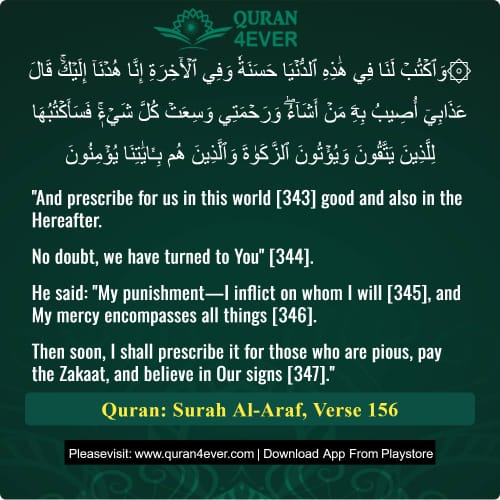
Transliteration:( Waktub lanaa fee haazi hid dunyaa hasanatanw wa fil Aakhirati innaa hudnaaa ilaik; qaala 'azaabee useebu bihee man ashaaa'u wa rahmatee wasi'at kulla shai'; fasa aktubuhaa lil lazeena yattaqoona wa yu'toonaz Zakaata wal lazeena hum bi Aayaatinaa yu'minoon )
"And prescribe for us in this world [343] good and also in the Hereafter. No doubt, we have turned to You" [344]. He said: "My punishment—I inflict on whom I will [345], and My mercy encompasses all things [346]. Then soon, I shall prescribe it for those who are pious, pay the Zakaat, and believe in Our signs [347]."
Hazrat Musa (on whom be peace) prayed for blessings in this world and the Hereafter, asking Allah to record good for them, whether in deeds or destiny. Worldly good includes guidance, honour among people, and elevated status, while the Hereafter's good refers to forgiveness and dignity on Judgment Day.
This prayer was made either for the seventy companions or for the entire Bani Israel. It shows that Prophets have the authority to represent and intercede on behalf of their people, especially when presenting their repentance to Allah.
Allah replied that the du‘a was accepted, but not for everyone. The reward of the Hereafter would not be granted to the entire nation, but only to those who meet specific conditions. This demonstrates that divine reward is selective based on deeds.
Allah’s worldly mercy, such as sustenance and safety, reaches all creation, both believers and non-believers. This does not mean Musa’s du‘a was rejected, but that it was granted with divine wisdom and distinction.
This promise refers to the pious followers of Prophet Muhammad ﷺ, who are not only believers but also fearful of Allah, pay Zakaat, and uphold divine signs. Their righteous traits were mentioned in earlier scriptures, while their faults were veiled—because this Ummah, though it may sin, belongs to the Beloved of Allah ﷺ.
The tafsir of Surah Al-A’raf verse 156 by Ibn Kathir is unavailable here.
Please refer to Surah A’raf ayat 155 which provides the complete commentary from verse 155 through 156.
(7:156) And ordain for us what is good in this world and in the World to Come for to You have we turned.’He replied: ‘I afflict whomsoever I wish with My chastisement. As for My mercy, it encompasses everything.[111] will show mercy to those who abstain from evil, pay Zakat and have faith in Our signs.’
111. It is false to assume that the general rule underlying God’s governance of His realm is that of wrath which is occasionally tempered with mercy and benevolence. On the contrary, the general rule is that of mercy and benevolence and wrath is the exception which is aroused when man’s transgression and rebellion exceed all reasonable limits.
For a faster and smoother experience,
install our mobile app now.
Related Ayat(Verses)/Topics