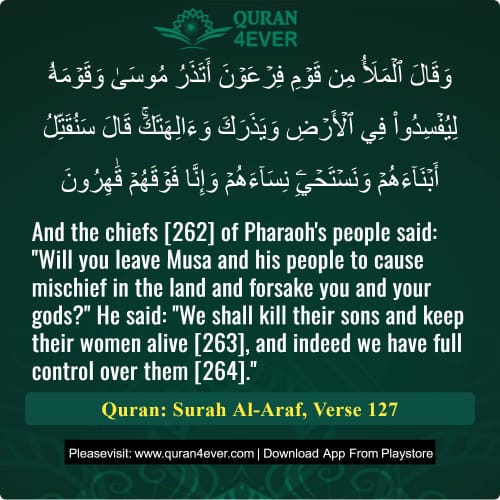
Transliteration:( Wa qaalal mala-u min qawmi Fir'awna atazaru Moosaa wa qawmahoo liyufsidoo fil ardi wa yazaraka wa aalihatak; qaala sanuqattilu abnaaa 'ahum wa nastahyee nisaaa'ahum wa innaa fawqahum qaahiroon )
And the chiefs (262) of Pharaoh's people said: "Will you leave Musa and his people to cause mischief in the land and forsake you and your gods?" He said: "We shall kill their sons and keep their women alive (263), and indeed we have full control over them (264)."
When the magicians prostrated in belief, it is said that around six hundred thousand people declared faith upon witnessing it. This alarmed the chiefs of Pharaoh’s court, who questioned why Pharaoh wasn’t taking harsh action against Musa. They were terrified that his message was rapidly spreading, and they feared a revolution of faith that would challenge Pharaoh’s divinity.
The phrase “your gods” refers to the idols given to the people by Pharaoh. While those close to him worshipped Pharaoh directly, the people in distant regions were given stone and wooden idols made in his image to worship. This state-enforced polytheism was central to Pharaoh’s power structure, and Musa’s message threatened to collapse this entire system.
Pharaoh responded with a policy of terror—ordering the killing of sons and sparing of daughters. The term “Nisaa” is metaphorically used here for young girls, implying they would be raised under the regime’s control and used to sustain the labor force. This brutal strategy was meant to crush the future of Bani Israel while maintaining their subjugation. Pharaoh boasted of his power, but his heart trembled with fear, as he was secretly overawed by Musa’s truth and presence.
127. The chiefs of Fir`awn’s people said: “Will you leave Musa and his people to spread mischief in the land, and to abandon you and your gods” He said: “We will kill their sons, and let their women live, and we have indeed irresistible power over them.” 128. Musa said to his people: “Seek help in Allah and be patient. Verily, the earth is Allah’s. He gives it as a heritage to whom He wills of His servants; and the (blessed) end is for the pious and righteous persons.” 129. They said: “We suffered troubles before you came to us, and since you have come to us.” He said: “It may be that your Lord will destroy your enemy and make you successors on the earth, so that He may see how you act”
Allah mentions the conspiracy of Fir`awn and his people, their ill intentions and their hatred for Musa and his people.
(The chiefs of Fir`awn’s people said), to Fir`awn,
(“Will you leave Musa and his people”), will you let them be free,
(“to spread mischief in the land”), spreading unrest among your subjects and calling them to worship their Lord instead of you Amazingly, these people were worried that Musa and his people would cause mischief! Rather, Fir`awn and his people are the mischief-makers, but they did not realize it. They said,
(“and to abandon you and your gods”) `Your gods’, according to Ibn `Abbas, as As-Suddi narrated from him, “Were cows. Whenever they saw a beautiful cow, Fir`awn would command them to worship it. This is why As-Samiri, made the statue of a calf that seemed to moo for the Children of Israel.” Fir`awn accepted his people’s recommendation, saying,
(“We will kill their sons, and let their women live”) thus reiterating his previous order concerning the Children of Israel. He had tormented them ﴿killing every newly born male﴾ before Musa was born, so that Musa would not live. However, the opposite of what Fir`awn sought and intended occurred. The same end struck Fir`awn that he intended to subjugate and humiliate the Children of Israel with. Allah gave victory to the Children of Israel, humiliated and disgraced Fir`awn, and caused him to drown along with his soldiers. When Fir`awn insisted on his evil plot against the Children of Israel,
(Musa said to his people: “Seek help in Allah and be patient”) and promised them that the good end will be theirs and that they will prevail, saying,
(“Verily, the earth is Allah’s. He gives it as a heritage to whom He wills of His servants; and the (blessed) end is for the pious and righteous persons.” They said: “We suffered troubles before you came to us, and since you have come to us.”) The Children of Israel replied to Musa, `they (Fir`awn and his people) inflicted humiliation and disgrace on us, some you witnessed, both before and after you came to us, O Musa’! Musa replied, reminding them of their present situation and how it will change in the future,
(“It may be that your Lord will destroy your enemy. ..”) encouraging them to appreciate Allah when the afflictions are removed and replaced by a bounty.
(7:127) The elders of Pharaoh’s people said: ‘Will you leave alone Moses and his people to spread mischief in the land, and forsake you and your gods?’ Pharaoh replied: ‘We will kill their male children and spare their female ones. [93] For indeed we hold irresistible sway over them.’
93. There were two periods of persecution. The first was during the reign of Rameses 11 and took place before Moses’ birth, whereas the second period of persecution started after Moses’ assumption to the office of prophethood. Common to both periods is the killing of the male issue of Israelites while the female was spared. It was a calculated design to rob the Israelites of their identity and to bring about their forcible assimilation. An inscription discovered during the archaeological excavations of 1896 probably belongs to this period. According to this inscription, Pharaoh Minpetah rounds off the narration of his achievements and victories in these words: ‘The Israel have been exterminated, and no seed of them is left.’ For further explanation see (al-Mu’min 40: 25)
For a faster and smoother experience,
install our mobile app now.
Related Ayat(Verses)/Topics