Transliteration:( Fa anjainaahu wa ahlahooo illam ra atahoo kaanat minal ghaabireen )
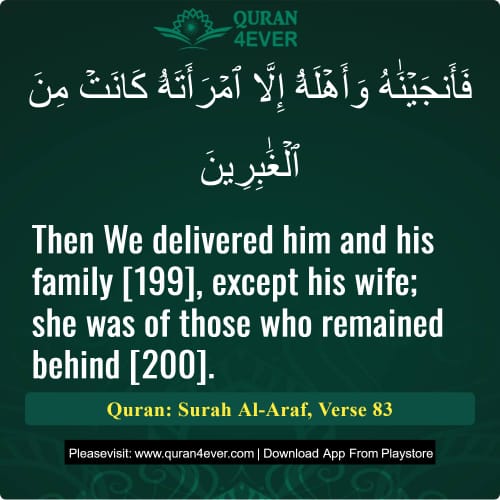
"Then We delivered him and his family [199], except his wife; she was of those who remained behind [200]."
From this verse, we learn that the family (Ahl) of a Prophet includes his children, wives, and household members. Therefore, the pious wives and children of the Holy Prophet ﷺ are counted among his Ahl-e-Bait. The Qur'an refers to Lut’s family in the same collective manner, confirming that a Prophet’s entire righteous household is included in this sacred designation.
The wife of Prophet Lut (عليه السلام) was named Wahila. She did not believe in his message and acted as an informer for the wicked people of her town. This teaches us that while a Prophet’s wife can be an unbeliever, she is never an adulteress—because Allah says:
"Corrupt women are for corrupt men" (Surah 24:26).
Despite being his wife, Wahila was spiritually disconnected from Lut (عليه السلام), and thus was not saved. However, his two daughters, Raooz and Reenta, and all other believing Muslims were rescued, while the rest of the nation was destroyed.
83. Then We saved him and his family, except his wife; she was of the Ghabirin (those who lagged behind). 84. And We rained down on them a rain (of stones). Then see what was the end of the criminals.
Allah said in another Ayah,
(So We brought out from therein the believers. But We found not there any household of the Muslims except one ﴿of Lut and his daughters﴾) ﴿51: 35-36﴾. Only his wife (from his family) did not believe, remaining on the religion of her people. She used to conspire with them against Lut and inform them of who came to visit him, using certain signals that they agreed on. This is why when Lut was commanded to leave by night with his family, he was ordered not to inform his wife or take her with him. Some said that she followed them, and when the torment struck her people, she looked back and suffered the same punishment as them. However, it appears that she did not leave the town and that Lut did not tell her that they would depart. So she remained with her people, as apparent from Allah’s statement,
(except his wife; she was of the Ghabirin) meaning, of those who remained, or they say: of those who were destroyed, and this is the more obvious explanation. Allah’s statement,
(And We rained down on them a rain) is explained by His other statement,
(And rained on them stones of baked clay, in a well-arranged manner one after another. Marked from your Lord; and they are not ever far from the wrongdoers.) ﴿11:82-83﴾. Allah said here,
(Then see what was the end of the criminals. ) This Ayah means: `See, O Muhammad, the end of those who dared to disobey Allah and reject His Messengers.’ Imam Ahmad, Abu Dawud, At-Tirmidhi, Ibn Majah, all recorded a Hadith ﴿from﴾ Ibn `Abbas who said that Allah’s Messenger said;
(Whoever is found doing the act of the people of Lut, then kill them; the doer and the one it is done to.)
(7:83) Then We delivered Lot and his household save his wife who stayed behind,[66]
66. As the Qur’an mentions elsewhere, Lot’s wife supported her disbelieving relatives to the last. Hence, when God directed Lot and his followers to migrate from that corrupt land, He ordained that Lot’s wife be left behind.
This seems to be an inference from( al- Tahrim 66: 10 – Ed).
For a faster and smoother experience,
install our mobile app now.
Related Ayat(Verses)/Topics