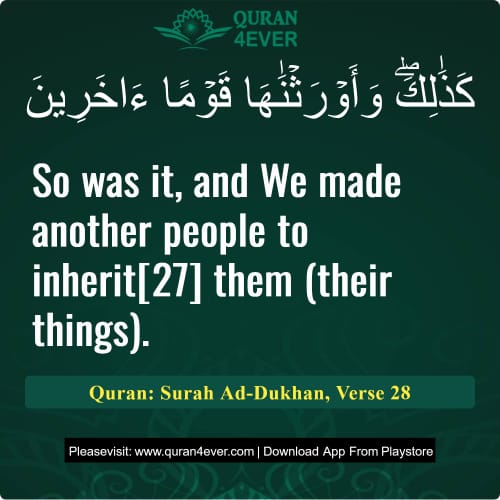
Transliteration:( Kazaalika wa awrasnaahaa qawman aakhareen )
"So was it, and We made another people to inherit [27] them (their things)."
This verse confirms the outcome of Pharaoh’s destruction—that all the wealth, gardens, palaces, and cultivated lands he and his people once possessed were transferred to another nation, namely the Children of Israel. This is a divine law repeatedly mentioned in the Qur’an: when a nation is destroyed for its arrogance and disbelief, their worldly possessions are inherited by the righteous or the oppressed whom they once dominated.
Here, the Israelites, who were previously enslaved by Pharaoh, became the successors of his wealth and land. Though some historical accounts claim otherwise, the Qur’an clearly affirms that the Israelites settled in Egypt after Pharaoh’s destruction, making the Qur’anic statement the authoritative truth.
This also resolves a juridical question: residing in the lands of disbelievers is not inherently forbidden. It is only forbidden to settle in areas where divine punishment has visibly descended, such as the ruins of Thamud or Sodom. In the case of Egypt, the punishment came upon Pharaoh and his army in the Red Sea, not upon the land itself. Therefore, Egypt remained permissible for habitation.
Another important point derived from this verse is that wealth abandoned by disbelievers, when seized without transgression, becomes lawful property of the believers. This rule is supported by other verses such as:
Surah Al-A'raaf (7:129): "It is near that your Lord will destroy your enemy and make you successors in the land."
Surah Al-A'raaf (7:137): "And We made the people who were oppressed inherit the eastern and western parts of the land."
Thus, this verse encapsulates a profound truth: Allah replaces arrogant nations with humble ones, and transfers control to those who are worthy, fulfilling both divine justice and mercy.
The tafsir of Surah Ad-Dukhan verse 28 by Ibn Kathir is unavailable here.
Please refer to Surah Dukhan ayat 17 which provides the complete commentary from verse 17 through 33.
(44:28) Thus it was; and We made another people inherit all that.[24]
24. Hasan Basri says that “other people” here implies the children of Israel, whom Allah made heirs of the land of Egypt after Pharaoh’s people, and Qatadah says it implies the other people who inherited Egypt after the people of Pharaoh, for the history does not make any mention that the Israelites ever returned to Egypt after the exodus and inherited it. This same point has been disputed by the later commentators also. For a detailed discussion, see (Surah Ash Shuara, Ayat 57-59) and the E.Ns on it.
For a faster and smoother experience,
install our mobile app now.
Related Ayat(Verses)/Topics